Blog
DAM and EasyCatalog: how to make your data reliable before automating your catalogues
Before automating catalogues with EasyCatalog and InDesign, make product data, EANs, prices, images and templates reliable with a well-structured DAM.
4 min readYasser LAKRAIMI
- DAM
- EasyCatalog
- InDesign
- Data Contract
- Retail

Poor data quality costs organisations an average of $12.9 million a year Gartner — Data Quality: Why It Matters and How to Achieve It. In retail, this hidden cost directly affects the graphic production chain and the profitability of catalogues. In this article, you will see how a DAM (Digital Asset Management) system lets you centralise your resources, make your information reliable and feed your publishing tools efficiently. From our work with retailers, we see that performance depends first and foremost on the quality of the source data.
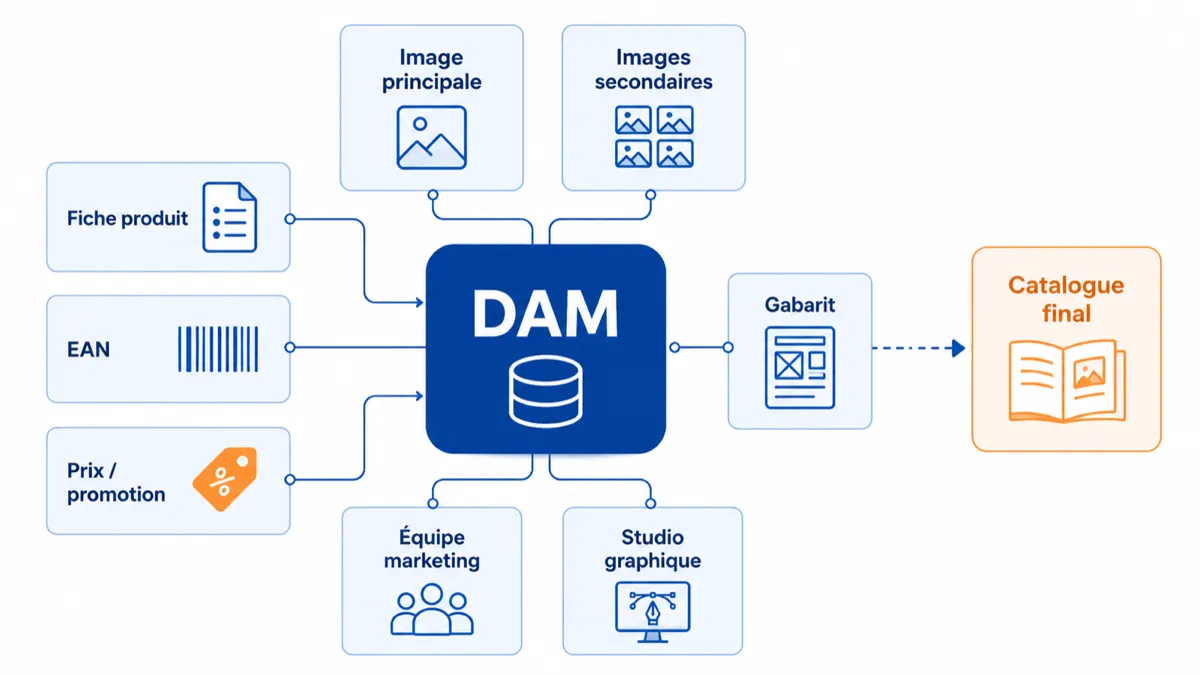
Centralising product sheets, EANs, prices, promotions and images in a DAM before generating the final catalogue with EasyCatalog and InDesign.
Why does catalogue production become fragile when data is scattered?
The complexity of producing a catalogue comes from coordinating very different elements: commercial data, images and promotional rules. This information is often scattered across local files, spreadsheets and email, which makes producing the materials fragile. The risk is both operational and commercial: 45% of shoppers have already returned a product because of inaccurate or incorrect content.
In addition, 78% of consumers consider product images and descriptions very important for completing a purchase. Without unified data, customer trust drops quickly when publishing errors appear. Internally, the graphic chain slows down and teams wear themselves out with ever more manual checks Salsify — New Shopping Survey Reveals Mindful Spending Trends.
The DAM: much more than a media library, a foundation for product governance
The DAM goes beyond the simple role of a media library to become the real control centre of your marketing strategy. It structures the product sheet by bringing together the EAN, pricing, promotional rules and associated images. Business teams no longer manage simple lists of references; they manage content packs ready for export.
Acting as a quality filter, the system identifies non-compliant images or empty fields before the layout is even created. In our roll-outs, we see that this kind of centralisation reduces back-and-forth corrections and gives teams back control over their offers.
The EAN: the pivot that secures the link between product and image
In an automated chain, the EAN identifier is the essential pivot between the data and the image. According to GS1 US, the barcode identifies more than one billion products and is scanned more than 10 billion times a day GS1 US — GS1 US Celebrates 50-Year Barcode “Scanniversary. Within the DAM, this unique reference makes the link between the product, its main image and its variants reliable.
Teams are thus freed from random naming conventions and time-consuming manual matching. Before such a repository is in place, approximations often create duplicates; afterwards, the product keeps full integrity across all materials.
The Data Contract: turning the DAM into a source EasyCatalog can use
Automation requires passing structured, intelligible information to your layout tool. The Data Contract concept formalises validation rules upstream, ensuring that only complete products reach EasyCatalog and Adobe InDesign.
If a mandatory attribute, such as the price or the image, is missing, the system can flag or block the line upstream to alert teams before layout.
This method turns a simple data export into a genuinely secure production interface. Graphic designers are freed from tedious data entry and can focus on the readability of the material and creative adjustments.
EasyCatalog and InDesign: from a static layout to a data-driven layout
Integrating EasyCatalog with InDesign replaces tedious manual copy-and-paste with a layout driven directly by the data. Structured information from the DAM (text, prices, images) can automatically feed the blocks of the document.
This automation greatly reduces the risk of errors and frees up the graphic studio, which can refocus on the visual quality of the material. The main operational advantage lies in the reliability of the flow: an update made at the source can be carried through to the layout, without a complete rebuild.
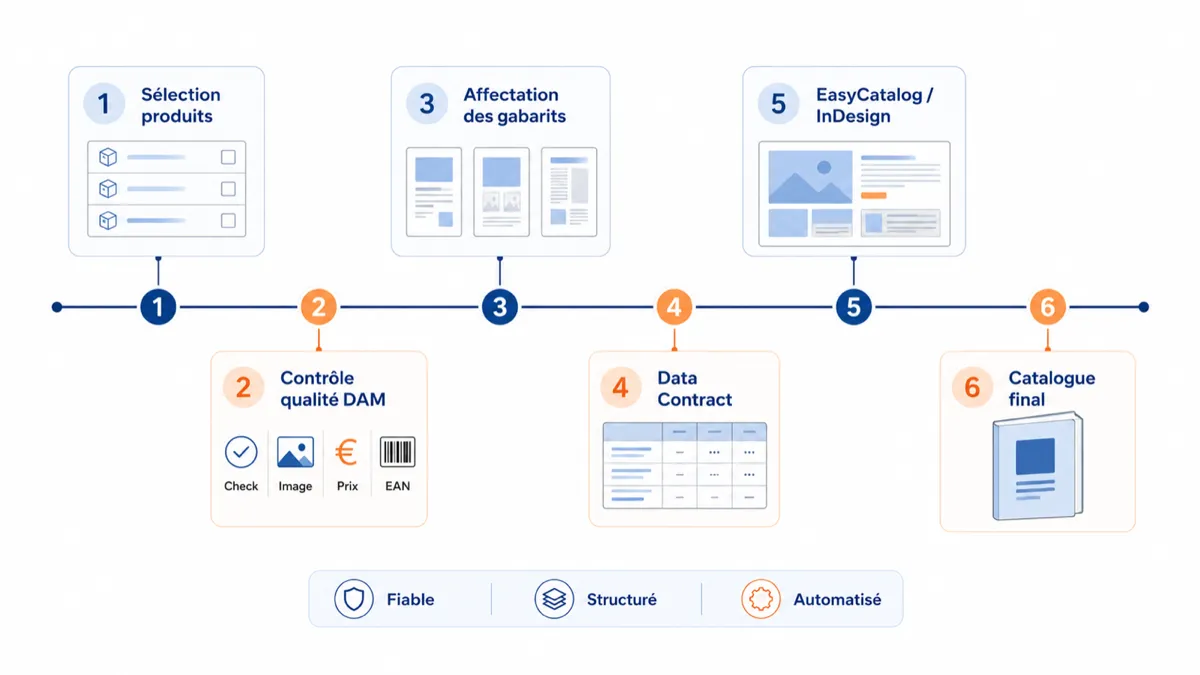
A reliable, structured and automated catalogue flow, from product data checks to final generation with EasyCatalog and InDesign.
What you can put in place right now
Before investing in automation, three actions help secure the foundations:
- Audit the rate of complete products, checking that the essential fields are present: EAN, image, price and template;
- Set a pivot identifier, such as the EAN, to make the link between products and assets reliable;
- Standardise a first promotional template, to test the Data Contract on a real case before extending it.
A data-driven catalogue is not built just by connecting tools. It relies first on the reliability of the data that feeds them.
The DAM structures products, secures assets and prepares flows that EasyCatalog and InDesign can use. The result: marketing works with reliable information, graphic designers work on content that is already prepared, and errors are caught before they reach the final layout.