Blog
When downstream systems go down: guaranteeing delivery of critical flows
Solace PubSub+ or WSO2 Micro Integrator: two approaches to automating error recovery and losing no messages when a downstream system goes down.
4 min readSalma EZZAYDY et Mohammed HAJJI
- Solace PubSub+
- WSO2 Micro Integrator
- Event-Driven Architecture
- Résilience
When a downstream system becomes unavailable, even temporarily, every message in transit becomes data at risk. Without a continuity mechanism, the integration drops the message without any alert: the loss is silent, and often irreversible.
This article presents two architectural approaches for automating error recovery and eliminating the loss of unique data in event pipelines: the first handled by the message broker (Solace PubSub+), the second by the integration layer (WSO2 Micro Integrator).
The business problem:
During activity peaks or system incidents, losing or blocking critical flows (orders, transactions, ERP synchronisations, business alerts) results in unprocessed orders, data discrepancies between systems, costly manual reconciliation and a loss of confidence in the integration systems.
Modern integration architectures carry unique data, produced only once: IoT measurements, financial events, critical business signals. This data cannot be regenerated. When a receiving system becomes temporarily unavailable, the integration drops the message, and the loss can go unnoticed for several hours.
The impact of a silent loss goes beyond the technical scope:
- Compromised integrity: master data inconsistencies that are costly to correct by hand.
- Regulatory exposure: risk of non-compliance in sectors where flows must be auditable.
- Loss of operational confidence: incidents detected by users before monitoring picks them up.
The central question is therefore no longer whether an outage will happen, but how to automate recovery without data loss or manual intervention.
Two approaches to automating recovery
Two distinct architectural choices address this issue of losing unique data and automating retries: one works at the event broker level, the other at the integration layer level.
Approach A — Delayed Redelivery & transacted session (Solace PubSub+)
Solace PubSub+ implements error recovery directly at broker level, through two combined mechanisms. The transacted session lets the consumer process a message within a local transaction: if processing fails, a rollback is triggered and the message becomes eligible for redelivery again, without ever being lost.
Delayed redelivery avoids overwhelming a system that is already struggling by spacing out attempts: a timer configured on the queue suspends delivery for an initial delay, then applies exponential backoff on each new failure, following the formula configured delay multiplied by the amplification factor raised to the number of attempts. If the maximum number of redeliveries is exceeded, the message is moved to a Dead Message Queue for manual analysis.
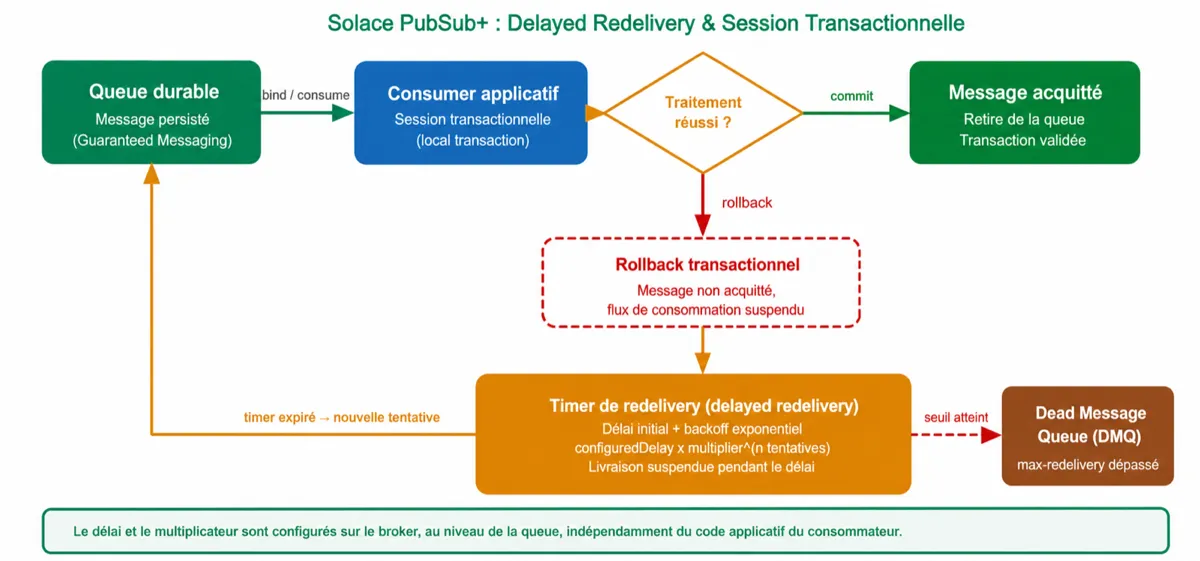
Delayed redelivery and transacted session mechanism on Solace PubSub+
The initial delay, the multiplier and the maximum redelivery threshold are configured on the broker at queue level, and passed automatically to the consumer when it connects, with no retry logic to develop on the application side.
Approach B — Store-and-Forward (WSO2 Micro Integrator)
WSO2 Micro Integrator implements error recovery at the integration layer, through a native Store-and-Forward model: the Message Store persists the message when the destination cannot be reached, and the Message Processor retrieves it periodically to attempt delivery, with a configurable retry strategy. After repeated failures, the message is redirected to a dead-letter store.
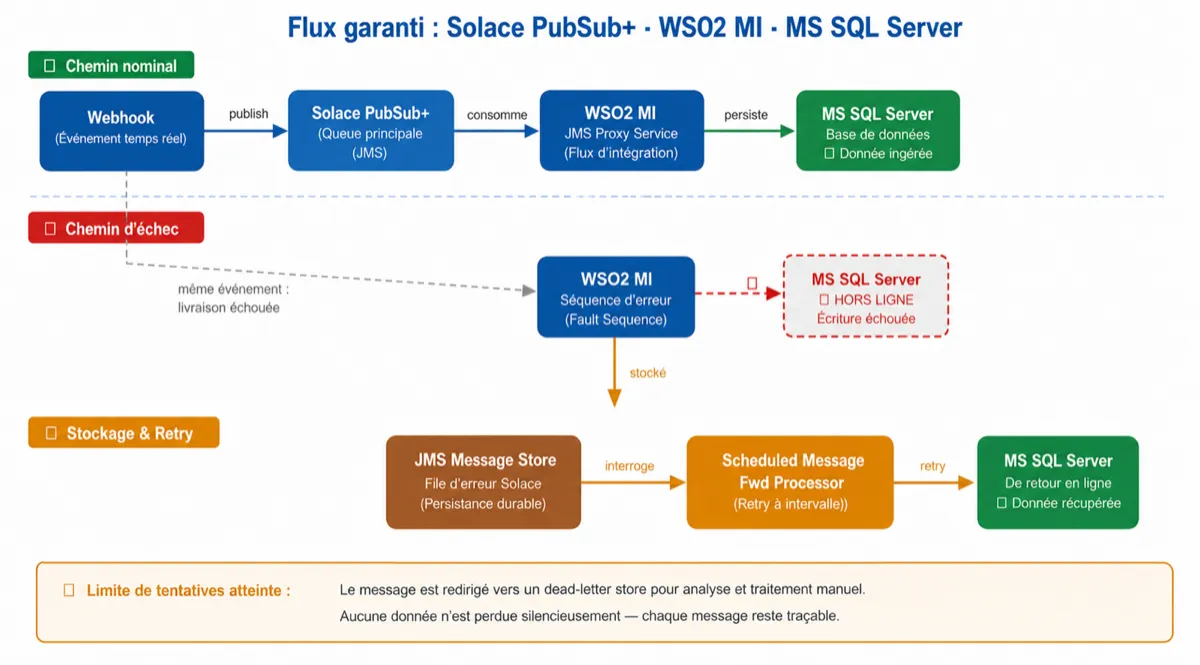
End-to-end flow on the WSO2 MI side: nominal path and recovery path (Message Store + retry).
In this model, persistence and retry logic are driven directly by the integration engine, as close as possible to the business processing rules, without relying on an external broker for recovery.
Comparison: advantages, complexity and limitations
| Approach A — Solace PubSub+ | Approach B — WSO2 MI |
|---|---|
| Advantages: retries handled natively by the broker, exponential backoff configurable without development, and no possible loss thanks to the queue’s guaranteed persistence. | Advantages: no dependency on an external JMS broker for retries, and declarative configuration as close as possible to the integration flow and business rules. |
| Complexity: requires a dedicated broker with the associated licence and operations; delayed redelivery configuration is a feature whose availability is controlled depending on the version. | Complexity: persistence depends on the WSO2 MI runtime; Message Store sizing must keep pace with the application load. |
| Limitations: transactional rollback and retries stay at transport level, less finely tied to specific business rules per message type. | Limitations: robustness under very high load peaks depends on the runtime’s capacity, without native absorption comparable to that of a dedicated broker. |
The choice between the two approaches depends on the context: favour Solace when retries must be handled as close as possible to the transport and guaranteed persistence, and WSO2 MI when recovery must be driven as close as possible to the integration’s business logic.
This dual approach applies to any sector where the reliability of event exchanges is critical: multi-channel synchronisation in retail, secure invoice exchange in e-invoicing, coordination of events between carriers and warehouses in logistics, or processing of business alerts in financial and industrial environments.
The experience gained on these two architectures highlights one lesson that applies across the board: the resilience of an event pipeline is built before the code, by choosing the level at which persistence and retries are driven. This architectural thinking, more than implementation complexity, is the foundation of a truly resilient integration.