Blog
Reducing API response times with WSO2 Micro Integrator
Chained calls, repeated data requests, an oversized tool: the three causes of a slow API, and how WSO2 Micro Integrator fixes them without touching your IT.
6 min readMeryeme CHIGUIR
- WSO2 Micro Integrator
- API
- Performance
- ERP
- Architecture d'intégration
An API that responds in 250 milliseconds rather than 900 does not do more: it does the same things without detours. Performance does not come from more powerful servers, but from the path, more or less direct, that each request follows before getting its response.
That path is often weighed down by calls made in sequence rather than in parallel — rather like a continuous integration pipeline that runs its tests one by one on a single agent, instead of spreading them across several runners. A shorter path means a smoother experience for your users, an infrastructure that takes the load without flinching, and costs that stay under control even when traffic climbs.
Three causes account for most slowness: calls chained one after another instead of grouped, information requested again for no reason, and a tool oversized for the actual traffic. Fixing them means taking back control of response time — without touching internal systems.
Why an API takes time to respond
In the vast majority of cases, three causes — and only these — explain a deteriorating response time:
- Systems are queried one by one. Like a CI pipeline that runs its tests one by one on a single agent instead of spreading them in parallel across several runners: each step adds its own delay, and those delays add up instead of overlapping.
- We ask again for what we already know. A price or a product record that almost never changes is still requested on every call — like doing a full DNS resolution on every request, when the result could stay in cache for a few minutes.
- The tool is bigger than the need. An engine designed for very complex flows takes longer to process a simple request — rather like deploying a full Kubernetes cluster to serve a simple static page.
How WSO2 MI tackles these three causes
WSO2 Micro Integrator (WSO2 MI) does not try to speed up the internal systems themselves — it changes the way they are called. The diagram below shows the path of a request: the client makes a single round trip, while behind the scenes WSO2 MI orchestrates caching, parallelism and connection reuse towards the internal systems.
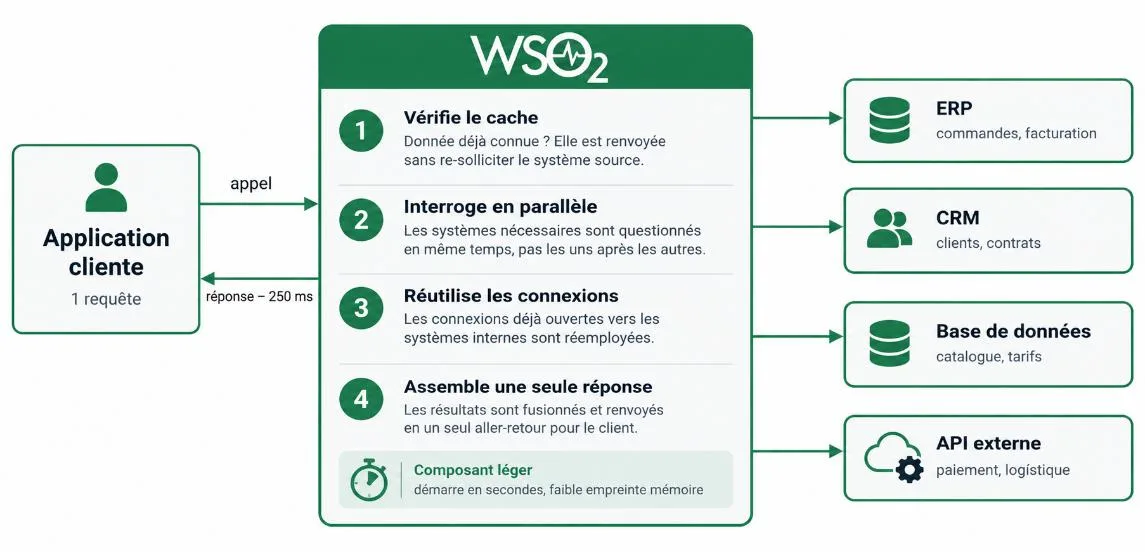
The client only sees one round trip: WSO2 MI absorbs the complexity of coordinating with the internal systems.
The techniques that make the difference
| What WSO2 MI does | Why it is faster | Gain |
|---|---|---|
| It remembers what rarely changes | A price or a product record does not need to be requested every time: WSO2 MI keeps it in memory. | High |
| It reuses connections that are already open | Rather than opening a new connection on every call, it reuses existing ones. | Medium to high |
| It queries several systems at the same time | It queries the systems in parallel and gathers the results — a single waiting time. | High |
| It runs on few resources | It starts quickly and uses little memory, unlike heavier tools. | Medium |
| It converts data formats directly | Format conversion happens internally, with no additional external service. | Medium |
WSO2 MI versus Boomi: performance put to the test
Boomi is a well-established integration platform with its own strengths. The comparison below deliberately focuses on performance, to see how the two tools cope when the volume of requests rises.
| Criterion | WSO2 MI | Boomi |
|---|---|---|
| Response time under heavy load | Stable and predictable: calls are parallelised and stable data is cached | Can lengthen significantly when active connectors and volume rise at the same time |
| Throughput at traffic peaks | Lightweight component, designed to be replicated as close as possible to the internal systems | Depends on the capacity allocated on the runtime infrastructure (Atom / Molecule) |
| Resources consumed | Minimal memory and CPU footprint, for maximum throughput with the same resources | Higher: the runtime ships more components |
| Start-up time | Just a few seconds — ready to absorb a peak as soon as it arrives | Longer, constrained by runtime provisioning |
| Network detours adding latency | Little or no detour: deployed as close as possible to the systems called | Exchanges often go through Boomi infrastructure, which adds a network hop |
To be fair: Boomi keeps real strengths outside this frame — ready-to-use connectors, centralised management, fast standard implementation. But on performance under heavy load, a lighter component deployed close to the internal systems absorbs peaks better.
Proof from a real case
At the end of every month, a company’s reporting team held its breath. Its critical API had to extract several thousand order and billing lines, but queried the ERP line by line, with no pagination or parallelisation, and requested reference data that almost never changes every single time. The result: extractions taking several tens of seconds, even slower during activity peaks (month end, closings) — exactly when the team needed them most.
| Before | After |
|---|---|
| ✕ Lines are extracted one by one, each blocked waiting for the ERP’s response | ✓ Batches of lines are extracted in parallel thanks to WSO2 MI, with no idle time |
| ✕ Reference data (customers, products) is requested again for every line, even when it does not change | ✓ Reference data that rarely changes is kept in memory and reused for all lines |
| ✕ Activity peaks (closings, month end) send extraction time soaring | ✓ The load is better spread, even during traffic peaks |
| ✕ Extracting several thousand lines takes several tens of seconds, or more under heavy load | ✓ The same extraction finishes in a few seconds, consistently, thanks to parallel batch processing |
| ✕ The API cannot go faster than the ERP it queries line by line | ✓ The API absorbs larger volumes without changing the ERP or internal systems |
The solution put in place
WSO2 Micro Integrator was deployed on this critical flow: lines retrieved in parallel batches, reference data kept in memory, ERP connections reused. Three targeted adjustments, without touching the ERP or the rest of the information system.
The same principle, valid across several sectors
- Retail & Distribution: prices and catalogues kept in memory; stock and orders processed at the same time to absorb peaks without keeping the customer waiting.
- Financial services: balances, accounts and histories retrieved at the same time, for faster banking applications — without compromising control or audit.
- Telecoms: billing and subscription management stay fast even during the most critical peaks (activation, campaigns).
- Logistics & Supply chain: carriers, warehouses and tracking coordinated in real time, with stable information kept in memory to save time on every shipment.
In summary
Why can the same request take 900 milliseconds in one case and 250 in another? Not because the servers are more powerful, but because the path is shorter: fewer chained calls, less information requested for nothing, and a tool sized for the actual traffic.
WSO2 Micro Integrator brings these three principles together out of the box — a pragmatic choice that pays off immediately, to gain speed, absorb load and stay competitive, without rebuilding everything.