Blog
Integration strategy: support your information system's transformation with a unified, evolving approach
Audit, data modelling, tool selection, governance: how to build an integration strategy and a hybrid platform that supports your information system.
5 min read
- Stratégie d'intégration
- Hybrid Integration Platform
- iPaaS
- API
A well-defined integration strategy is an essential lever for structuring digital transformation.
It is not just about choosing a tool or a vendor: it is a decision-making framework that guides the capabilities to put in place to meet the organisation’s priorities. Whether the aim is to synchronise data, automate processes or build a modular architecture, an integration strategy aims to strengthen control over the information system and create a lasting competitive advantage.
We Are Beebay brings multi-technology expertise to design unified, robust and evolving Hybrid Integration Platforms (HIP). Building on high-performing solutions such as Boomi, Workato, Microsoft, Gravitee and Solace, the goal is to build an integration platform that becomes the anchor point of the enterprise architecture. This cross-cutting layer makes exchanges between applications easier, secures the flow of data and allows the organisation to absorb functional changes with agility.
What is an integration strategy?
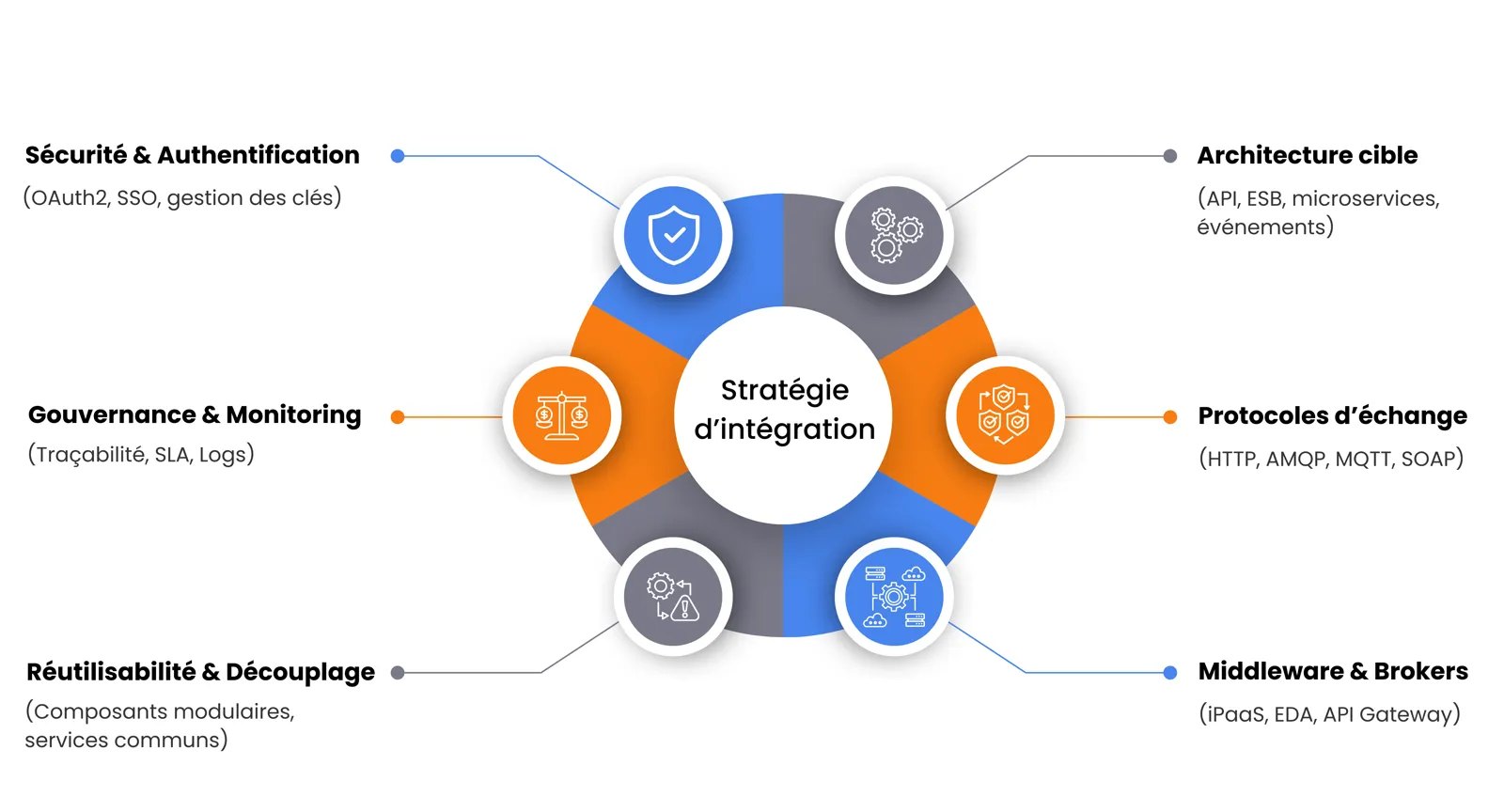
An integration strategy is much more than a set of connectors or technical tools. It is a structuring decision-making framework that defines the capabilities to integrate, the implementation patterns to favour and the interoperable services to industrialise. It aims to align technical architecture choices with business imperatives, while ensuring consistency, scalability and governance.
This foundation guarantees the interoperability, resilience and scalability of exchanges between applications, while keeping technical debt under control. It encourages the logical decoupling of components, making the ecosystem more agile in the face of functional changes, load increases or migrations of parts of the information system.
Far from being an isolated technical project, integration becomes a structuring lever for rationalisation, shorter time-to-market and operational continuity. When it is designed as an evolving architectural foundation, it becomes a real accelerator of digital transformation for the whole organisation.
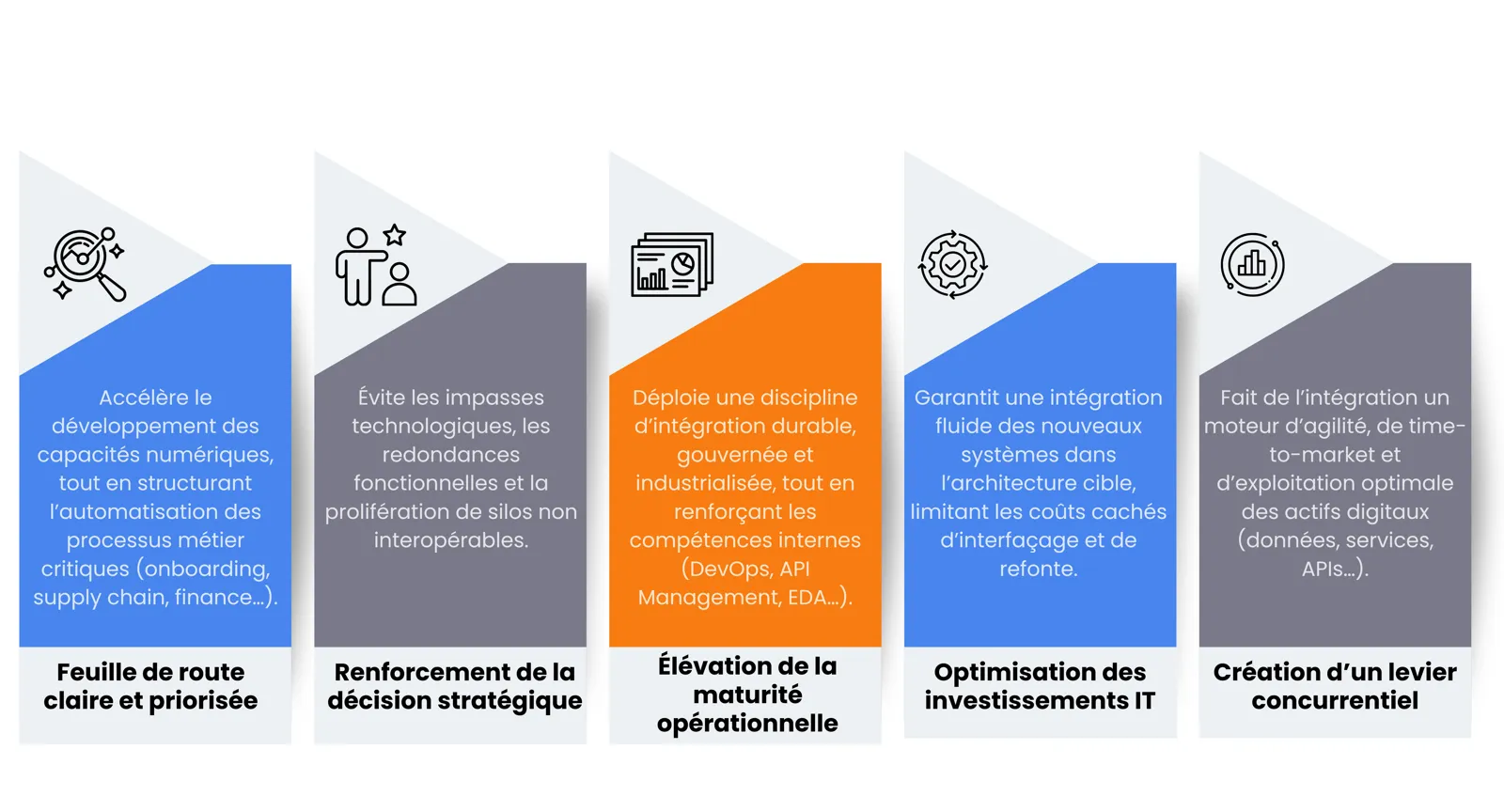
What you gain with a real integration strategy:
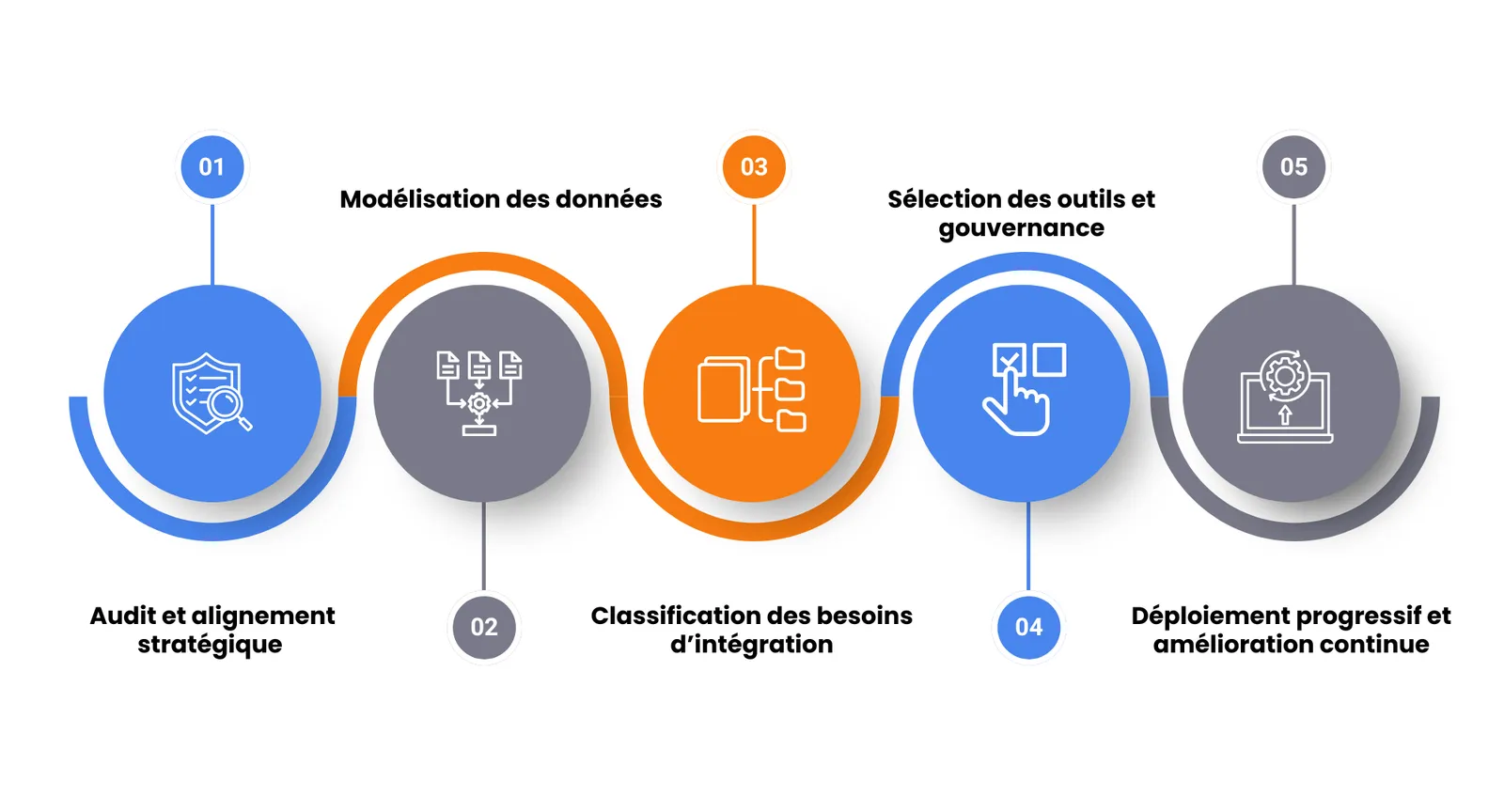
How do you develop an integration strategy?
Putting an integration strategy in place is not just about piling up tools or connecting systems opportunistically. It is a structured approach that aims to build a consistent, evolving architecture aligned with business priorities. At a time when data flows are becoming critical assets and speed of execution makes the difference, scoping needs, structuring data models and choosing the right technology levers becomes essential. This upfront thinking determines the organisation’s ability to automate, to evolve without disruption, and to keep control over the growing complexity of its information system.
- Audit and strategic alignment:
- Analysis of existing systems, mapping of flows and identification of existing capabilities.
- Assessment of the key business processes to automate.
- Prioritisation of integration needs according to their strategic and operational impact.
- Data modelling as the foundation of integration:
- The performance of an integration strategy depends heavily on the quality of the data handled.
- Putting in place robust data models to make transformation and reuse easier.
- Using canonical models or business object models to abstract away the specifics of source systems and build shared semantics.
- An agile or iterative approach is recommended, modelling only the entities critical to the target process.
- Classification of integration needs:
- Data consistency: synchronising systems to ensure uniform, reliable information.
- Multi-system process orchestration: automating cross-functional workflows involving several applications.
- Composite services: aggregating data from different sources to create unified business interfaces or services.
- Tool selection and governance:
- Several technologies are often combined (iPaaS, API Gateway, Event Broker…) to cover the different use cases.
- A clear governance framework is needed to ensure the consistency, security and monitoring of flows.
- Gradual roll-out and continuous improvement:
- An iterative approach focused on high-value use cases, with fast go-live.
- Building on existing components (data models, connectors, services) and upskilling internal teams.
- Setting up performance indicators and continuously adjusting the integration foundation based on usage feedback.
How do we support the implementation of your integration strategy?
We Are Beebay relies on advanced technical expertise and an ecosystem of certified partners (Boomi, Workato, Microsoft, Gravitee, Solace) to design tailored integration strategies, suited to the complexity of your information system.
Our teams get involved from the early stages through architecture audits, technical and functional demonstrations and targeted Proofs of Concept (POC), so that the fit between solutions, business requirements and technical constraints can be validated quickly.
The approach aims to lay the foundations of a unified Hybrid Integration Platform (HIP), able to orchestrate heterogeneous flows, handle real-time events and manage the governance of exchanges between applications. It ensures smooth orchestration of flows, strengthens governance of exchanges, and allows your information system to scale under control, while keeping your integration architecture consistent and able to evolve.
- Assess the existing integration foundation: map current capabilities (iPaaS, APIs, brokers, batches…), analyse the technical architecture, the critical processes to interface and the level of maturity in flow governance.
- Define a target trajectory: set out an architecture vision aligned with business objectives, including criteria for scalability, time-to-market, cost control and resilience.
- Design and run an integration platform: build a modular, evolving architecture, deploy the right components (API Gateway, EDA, orchestrators, repositories), and put in place management, monitoring and lifecycle management capabilities.
Use case: manufacturing industry
While supporting a major player in the manufacturing industry, we designed a unified data architecture integrating:
- ERP: Sage X3
- CRM: Salesforce
- Integration platform: Boomi
- Storage & analytics: Microsoft Fabric
- Reporting: Power BI
The flows between applications (customers, orders, products, statuses) were automated, ensuring:
- Real-time synchronisation between sales and operations teams
- Elimination of manual errors and double entry
- Shorter processing times
- Consolidated indicators in near real time
- Greater sales responsiveness thanks to a unified view of the data
Conclusion: make integration a strategic lever
A well-designed integration strategy, driven by the right tools and anchored in a hybrid architecture, is a catalyst for the performance and resilience of your information system.
We Are Beebay helps companies build a Hybrid Integration Platform that can support your digital ambitions, automate your critical processes and guarantee the consistency of your data.