Use case
Automating e-invoicing integration with Boomi
E-invoicing reform: an Edicom, Boomi and Infor M3 architecture that moves invoices in both directions, built around a canonical format.
4 min readSalma EZZAYDI
- Boomi
- Infor M3
- Facturation électronique
- ERP
- iPaaS
- Architecture d'intégration
Regulatory context
In France, the e-invoicing reform is coming into force in stages. Since 1 September 2026, all companies must be able to receive electronic invoices; large companies and mid-sized companies (ETIs) must also be able to issue them. SMEs and micro-enterprises will be subject to the issuing obligation from 1 September 2027.
The reform relies in particular on the use of approved platforms for exchanging electronic invoices and for the data transmissions required by the scheme. For companies, this change therefore means connecting the e-invoicing platform effectively to the ERP system. An invoice should no longer be seen as a simple document, but as business data that must be carried and transformed end to end.
At European level, this shift is also continuing with the ViDA package, adopted in 2025, which notably provides for new digital reporting requirements for cross-border B2B transactions from 2030.
The business problem
The widespread use of e-invoicing turns the invoice into a structured data flow that must move automatically between information systems. For a company using Edicom as its e-invoicing platform and Infor M3 as its ERP, the real challenge is therefore not simply to transmit an invoice: it is to guarantee that the data is correctly received, understood, transformed and integrated into the target system, while ensuring its traceability.
How can electronic invoice exchanges between Edicom and Infor M3 be automated, in both directions, while guaranteeing data compliance, consistency with the ERP’s master data and the ability to handle different formats and regulatory changes?
Without a suitable integration layer, every new format, partner or change to the M3 model can require specific development. The risk is then to multiply interfaces and mappings, make maintenance more complex and make error handling dependent on manual intervention. It is in this context that Boomi acts as the integration hub between Edicom and Infor M3.
A simple architecture: Edicom — Boomi — Infor M3
Boomi sits between the e-invoicing platform and the ERP to centralise exchanges, transformations and integration rules.
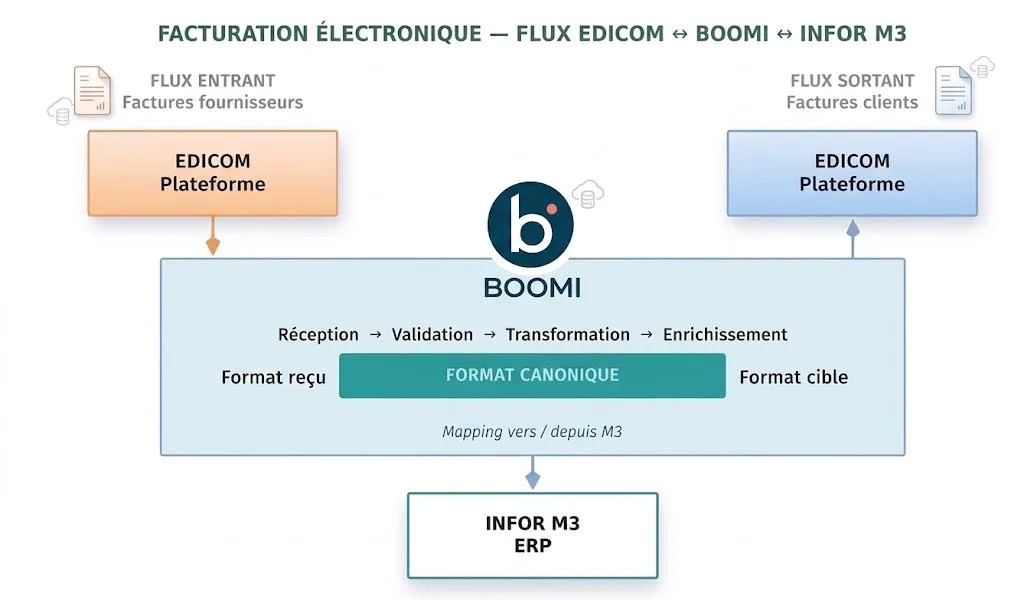
Inbound flow (supplier invoices) and outbound flow (customer invoices) orchestrated by Boomi.
The benefit of this architecture is that it separates responsibilities:
- Edicom handles the electronic exchange of invoices;
- Boomi handles data integration, transformation and orchestration;
- Infor M3 remains the system of record for business data and processes.
The role of the canonical format
The key point of the architecture is the use of an internal canonical format. Invoices may arrive from Edicom in different structured formats depending on the flow or context: for example Factur-X, UBL or CII. Rather than developing a specific transformation between each format and Infor M3, Boomi first transforms the data into a common model.
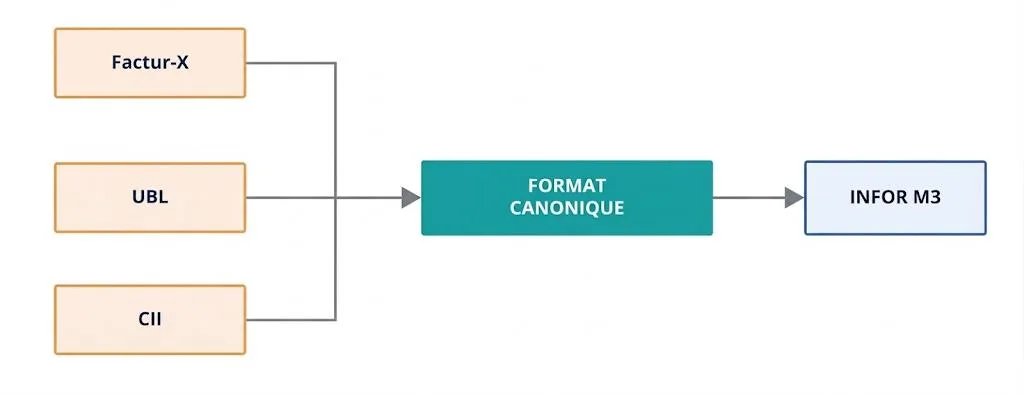
External formats converge into a common model before integration into M3.
This approach makes it possible to decouple external formats from the ERP’s data model. For example, if a new format has to be integrated tomorrow, you only need to develop the new format → canonical format transformation, rather than rework the whole interface with M3. Likewise, if M3’s data model changes, the mapping between the canonical format and M3 can be adapted without modifying the interfaces with the various external formats.
The added value of Boomi as a hub
Boomi’s main value is not just carrying files. It makes it possible to centralise the integration logic between Edicom and Infor M3.
- Reusable mapping logic. Transformations are centralised around the canonical format. This makes it easier to add new formats, partners or countries without calling the whole architecture into question.
- Separation between business logic and technical formats. Edicom may change, a new format may appear or M3 may modify its data model: the changes stay isolated in the transformation layers concerned.
- Centralised error handling. Boomi distinguishes communication errors from functional errors. A temporary outage of M3 or Edicom can be handled by a retry, whereas an invoice containing invalid business data must be rejected and flagged for correction.
- Better traceability. Each invoice can be followed along its journey (Edicom → Boomi → M3 or M3 → Boomi → Edicom), which makes diagnosis easier when an invoice is rejected, blocked or not integrated.
- A more scalable architecture. The same mechanism can then be extended to other company systems or to new flows, without systematically creating point-to-point connections.
Conclusion
Above all, the e-invoicing reform requires rethinking the invoice as an automated data flow, and no longer as a simple document. In an Edicom — Boomi — Infor M3 architecture, Boomi acts as the hub between the invoicing platform and the ERP. Its value is particularly visible in handling both directions of the flow, normalisation through a canonical format, reuse of mappings, error handling and traceability.
This architecture therefore meets the immediate need created by the French reform, while building an integration able to evolve with new formats, new partners and future European requirements.