Blog
iPaaS integration of Divalto, Salesforce and Infor M3: orchestrating business flows with Boomi
An iPaaS architecture with Boomi to connect Salesforce, Divalto and Infor M3, automate data exchanges and ensure the quality of customer data.
3 min readZakaria OBOHOU
- Boomi
- Salesforce
- Divalto
- Infor M3
- iPaaS
As companies’ information systems grow ever more complex, integrating business applications has become a strategic issue. Companies often use several solutions, such as an ERP (Infor M3), a CRM (Salesforce) and specific business tools such as Divalto. To make these systems communicate effectively, an iPaaS platform such as Boomi becomes a central solution.
1. How to connect Salesforce, Infor M3 and Divalto through an iPaaS platform
Industrial and trading companies generally use three complementary systems:
- Salesforce for customer relationship and opportunity management
- Infor M3 for production, stock and logistics
- Divalto for sales management, sales and invoicing
Without integration, these tools work in silos, leading to duplicate data entry, data inconsistencies and a lack of overall visibility.
The iPaaS connects these systems and automates the exchanges:
- Connection to the three applications through APIs or connectors
- Data mapping between the systems
- Flows defined according to business events
- Automatic synchronisation in real time or in batch
2. Boomi’s role in the integration architecture
Boomi is a cloud iPaaS platform that quickly connects SaaS, on-premise or hybrid applications.
Its main advantages:
- Ready-to-use native connectors (Salesforce, databases, ERPs…)
- A low-code interface to speed up development
- Centralised management of integration flows
- Real-time monitoring and error handling
Boomi acts as a central hub between Divalto, Salesforce and M3.
3. A typical integration architecture
A classic integration architecture is generally organised as follows:
- Salesforce ↔Boomi ↔ Infor M3: synchronisation between customer relationship and production/stock.
- Divalto ↔ Boomi ↔ Salesforce: data flowing between sales management and the CRM.
- Divalto ↔ Boomi ↔ Infor M3: link between invoicing/field sales and logistics.
In this setup, Boomi acts as a central orchestration layer:
- Data transformation and adaptation (formatting, mapping)
- Coordination of business processes between the systems
- Synchronisation of flows in real time or in batch mode
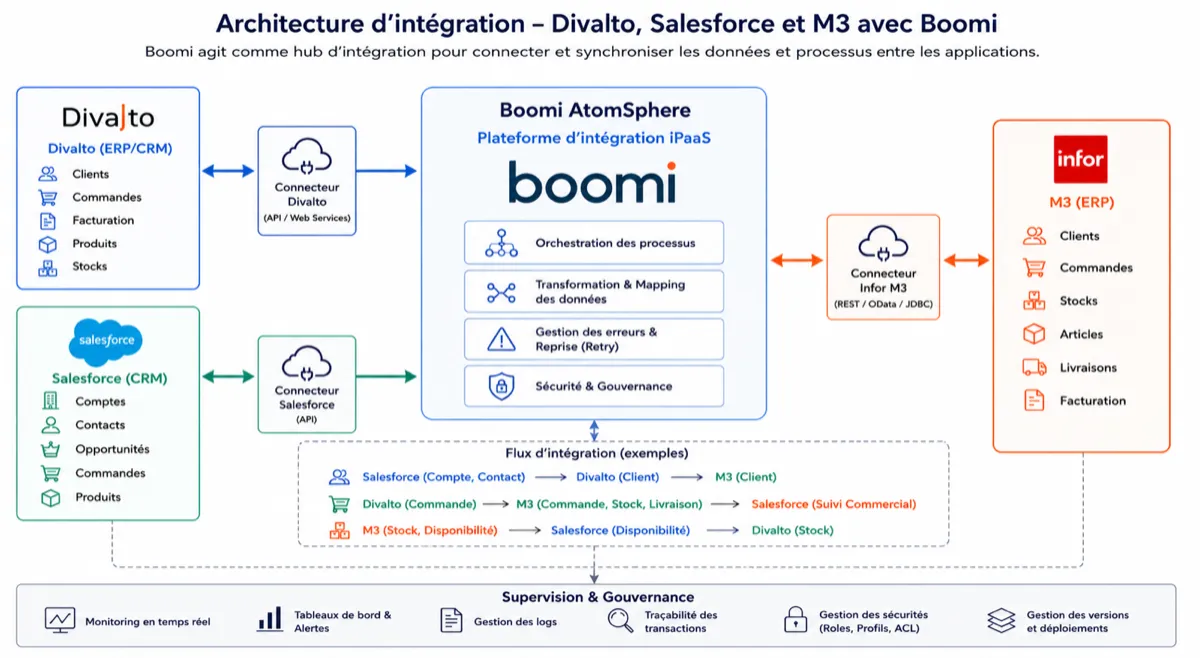
Boomi acts as a central hub to synchronise data and processes between Divalto, Salesforce and Infor M3.
4. Concrete use cases
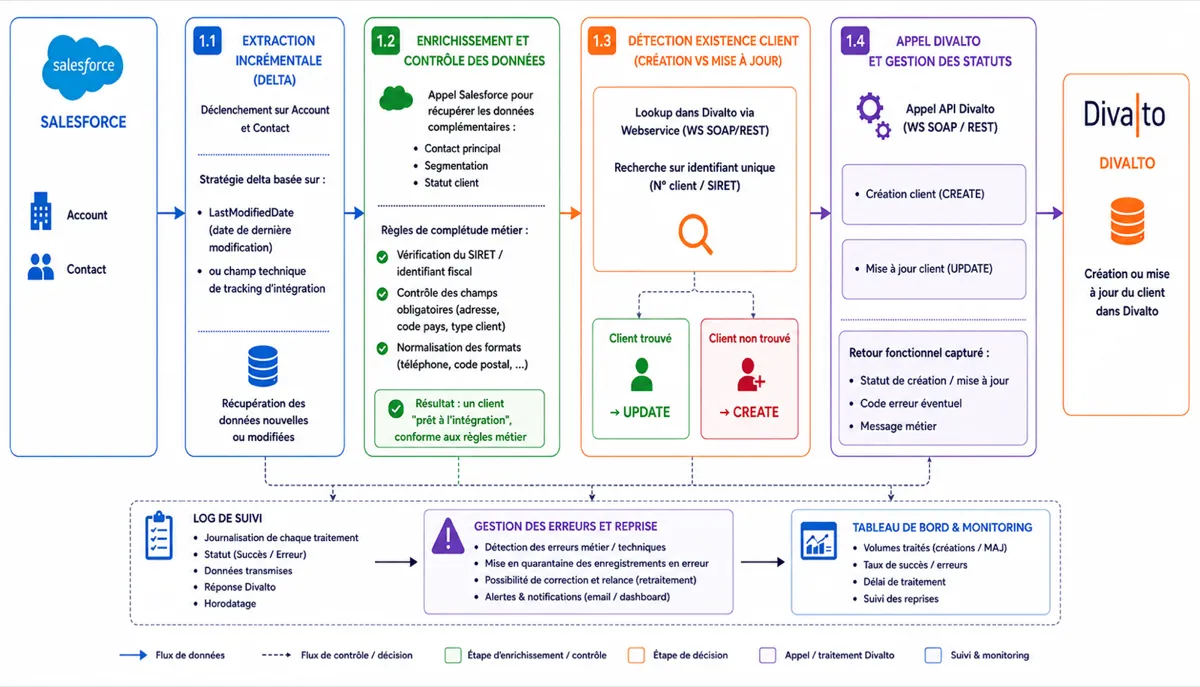
A reliable Boomi flow to synchronise customers between Salesforce and Divalto, from data checks to processing follow-up.
The goal of this use case is to ensure reliable, controlled and automated synchronisation of customers between Salesforce and Divalto, while guaranteeing data quality and uniqueness, through exchanges based on REST APIs.
More precisely, it aims to:
Ensure that every customer creation or update in Salesforce is correctly passed on to Divalto without duplicates or inconsistencies, by exposing and consuming secure REST API services.
To achieve this, the flow sets several key operational objectives:
- Optimise data exchanges (delta mode) so that only new or modified customers are processed, through targeted REST API calls
- Ensure customer data quality through business checks (SIRET, addresses, formats, mandatory fields) before sending through the API
- Standardise and enrich customer information before it enters the Divalto ERP through the REST exposure layer
- Avoid duplicates through existence detection (CREATE vs UPDATE) carried out via REST API endpoints on the Divalto side
- Secure the integration with a status return, a structured API response mechanism and centralised tracking of REST call errors
Integrating Salesforce, Divalto and Infor M3 through an iPaaS approach driven by structured business flows profoundly changes how data is managed within the company.
Beyond simply connecting applications, this kind of set-up establishes a continuous, reliable value chain, in which every piece of customer data is checked, enriched and synchronised consistently across the different systems. The Salesforce → Divalto customer flow illustrates this logic perfectly, combining incremental extraction, business rules, existence checks and full traceability of exchanges.
This approach not only guarantees data quality and uniqueness, it also helps reduce operational errors, make sales processes more reliable and speed up processing cycles.