Blog
Modernising an information system without rewriting everything: the art of progressive transformation
Strangler Fig, Dual Write, CDC, API Gateway: modernising a legacy information system module by module, without a full rewrite, with a realistic roadmap.
5 min readAbir ZAIM
- Modernisation SI
- Strangler Fig
- API Gateway
- CDC
- Legacy
1. WHY NOT REWRITE EVERYTHING
A complete overhaul of an information system (greenfield) remains the riskiest choice in digital transformation. More than 70% of projects of this kind exceed their initial budget, and the competitive window closes during the 2 to 3 years the programme lasts.
Progressive architectures, by contrast, deliver value from the first weeks, preserve service continuity and keep costs under control. They rely on proven patterns — Strangler Fig, Dual Write, API Layer — to replace the legacy module by module, without ever shutting down production. This article presents the mechanisms, the pitfalls and an actionable roadmap.
2. STRANGLER FIG PATTERN — EXTRACT WITHOUT CUTTING OFF
The Strangler Fig Pattern consists of building the new system alongside the legacy, gradually diverting traffic through a proxy. The old code is decommissioned module by module, without ever interrupting production. Here is how to implement it in practice.
| Step | Concrete action | Exit criterion |
|---|---|---|
| 1 — Facade | Deploy an API Gateway (Kong / NGINX / Azure APIM) in front of the legacy. All traffic goes through this single point. | 100% of traffic routed through the facade, observability enabled (logs, traces). |
| 2 — Shadow mode | The new service runs in parallel. It receives a copy of the requests with no impact on production, and its responses are compared with the legacy responses. | Divergence rate < 0.5% over 10,000 requests. |
| 3 — Progressive switchover | Feature flags: route 5% → 20% → 50% → 100% of traffic to the new service. One-click rollback in case of error. | New service SLA ≥ legacy SLA. Zero functional regression. |
| 4 — Decommission | Disable the corresponding legacy module. Clean up the data schema. Move on to the next subdomain. | Legacy code removed from the repository. Licences released. |
Deciding which module to extract first
Prioritisation criteria — scored 1 to 3
- High frequency of business change → score 3 (e.g. pricing engine)
- Low coupling with the rest of the information system → score 3 (e.g. notifications module)
- Direct customer impact → score 2 (e.g. customer portal, sign-up)
- High annual maintenance cost → score 2 (e.g. fragile overnight ETL batch)
- Stable, documented business rules → score 1 (e.g. regulated accounting)
→ Start with the subdomain with the highest score.
3. CONTROLLED COEXISTENCE — SYNCHRONISATION PATTERNS
During the coexistence phase, both systems must stay in sync. Two patterns compete, depending on the level of consistency required and the tolerance for intrusiveness.
Dual Write writes to both databases at the same time from the application layer — strong consistency, but compensation is mandatory in case of partial failure.
Change Data Capture passively captures changes from the legacy database’s transaction log and propagates them through Kafka — zero change to the legacy code, but eventual consistency: when a piece of data is modified in the source (the legacy database), that change has to travel to the target system (the new information system). The journey takes time, even if that time is short (a few hundred milliseconds to 1 second with a well-configured Kafka). During that interval, the two systems see different data. Eventually, they converge on the same state.
The choice between the two depends on a single criterion: can you accept a propagation delay, however small?
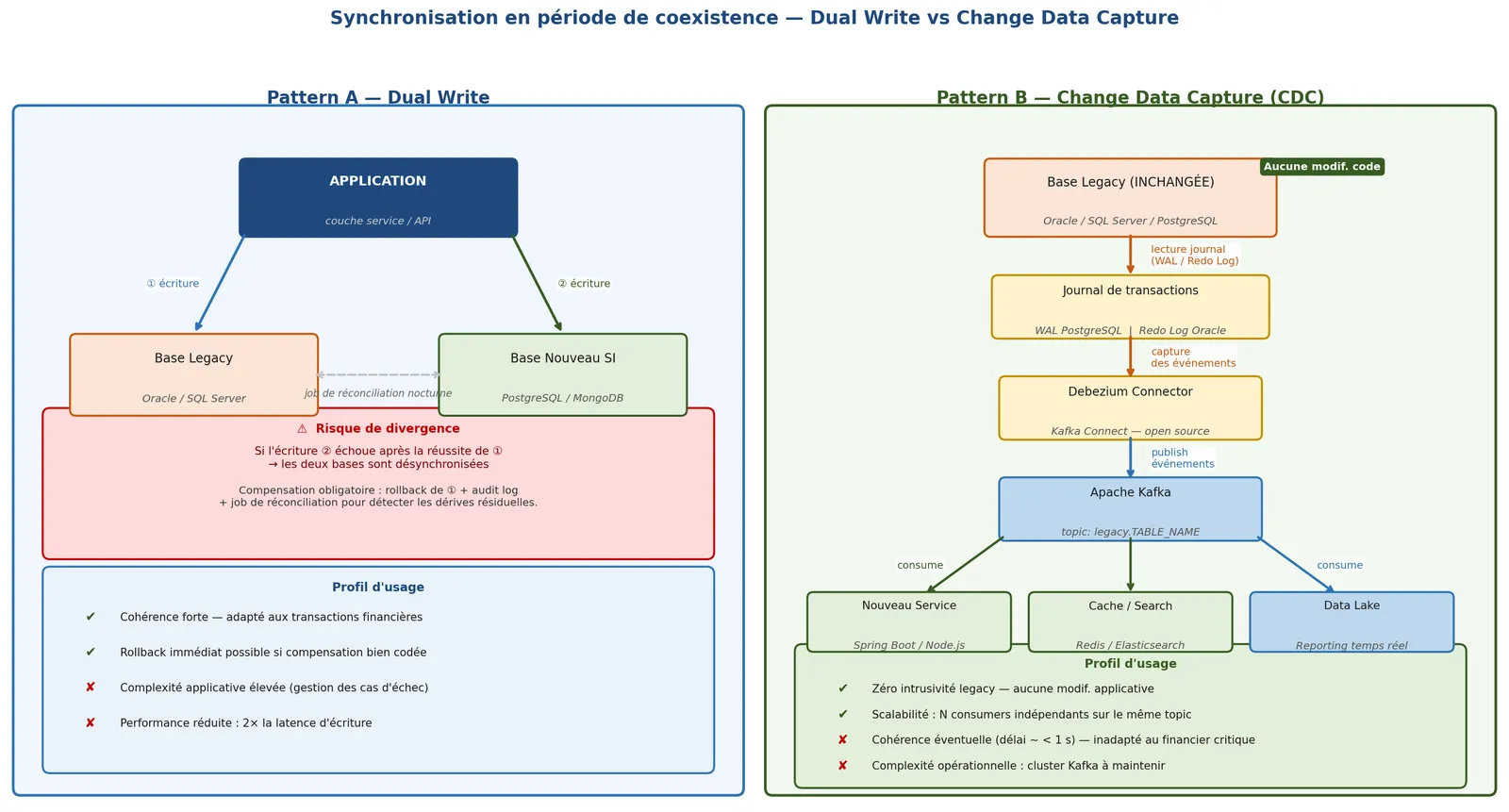
Two approaches to keeping the legacy and the new information system consistent during a progressive migration: Dual Write for strong consistency, CDC for less intrusive, more scalable synchronisation.
4. THE API LAYER — EXPOSING THE LEGACY WITHOUT TOUCHING IT
Placed in front of the legacy information system, the API Gateway acts as a universal translator: it receives modern calls (REST/JSON, GraphQL, gRPC) from consumers, converts them into the format the legacy expects (SOAP/XML, direct database calls), then returns a normalised response.
The legacy source code is never modified. On the left, the legacy components keep working exactly as before. In the centre, the Gateway enables versioning, centralises security and creates the control point for all future routing. On the right, modern consumers access clean, versioned APIs documented with OpenAPI 3.0.
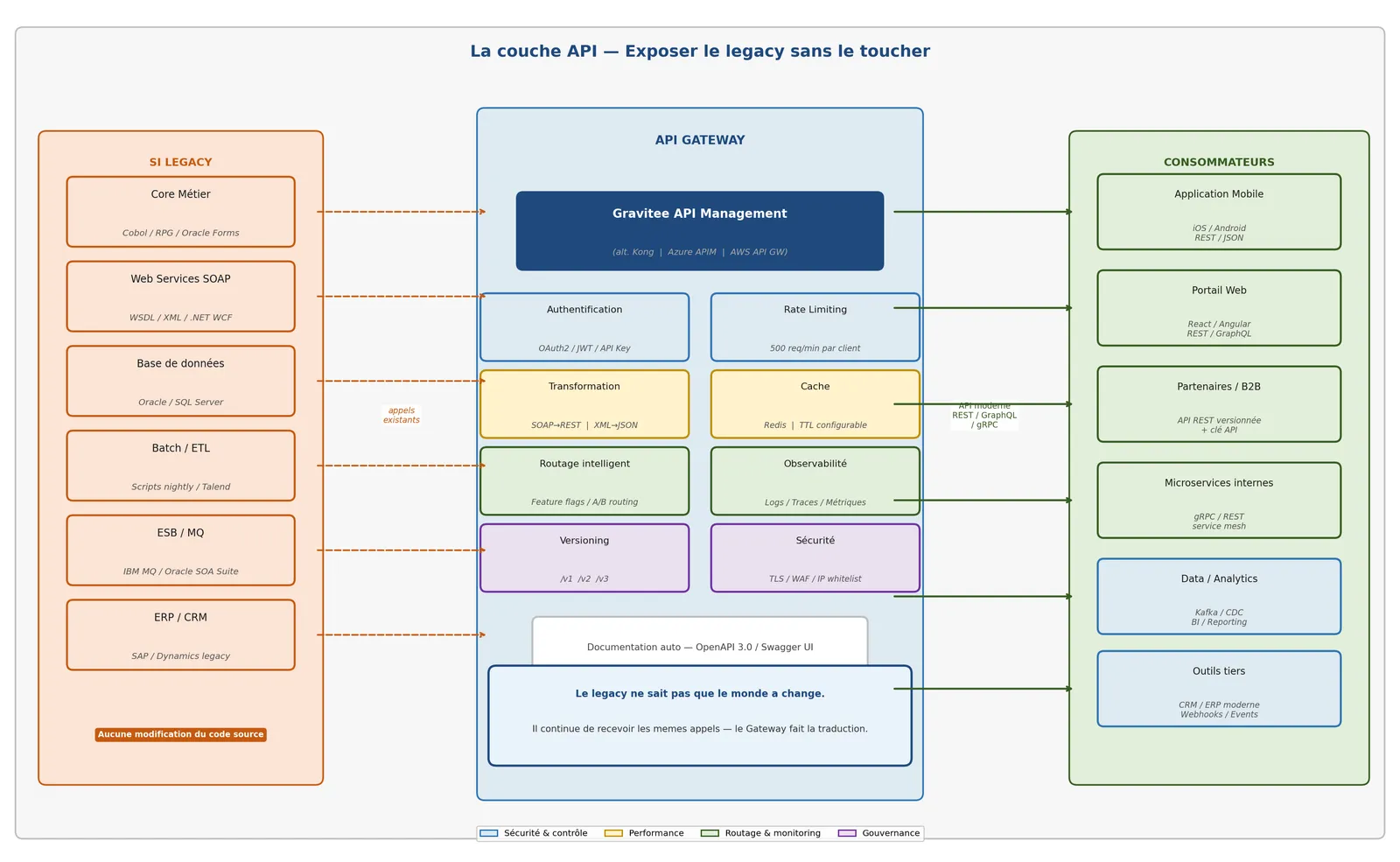
The API Gateway acts as a facade layer: it secures, transforms, routes and versions exchanges between the legacy and new digital uses.
5. PROGRESSIVE MIGRATION: THE REALISTIC ROADMAP
Progressive modernisation is not a fixed project: it is an iterative programme structured in phases. Here is the roadmap we apply on our transformation engagements, suited to mid-sized IT departments (50 to 500 IT staff) in the French and Moroccan market.
| Phase | Key actions | Deliverable |
|---|---|---|
| 1 — Assess Assessment | Mapping of the information system, identification of business domains, technical debt scoring, business interviews. | Assessment report, prioritised modernisation backlog. |
| 2 — Wrap Encapsulation | API Gateway deployment, facade in front of the legacy, CDC set up if needed. | Legacy accessible through API, observability enabled: logs and traces. |
| 3 — Extract Extraction | Breakdown into subdomains, development of the new services, characterisation tests. | New microservices in shadow mode, functional parity validated. |
| 4 — Replace Switchover | Feature flags, progressive traffic switchover from 5% to 50%, then to 100%, enhanced monitoring. | Legacy module disabled, new service at 100% in production. |
| 5 — Decommission Disengagement | Removal of legacy code, clean-up of orphaned data, documentation update. | Simplified information system, lower licence and infrastructure costs. |
6. CONCLUSION — START SMALL, MEASURE, ITERATE
Progressive modernisation is not a timid compromise: it is a mature engineering strategy, used by Amazon, Netflix and Booking.com to migrate their monoliths without ever cutting off service. It is not an event, it is a continuous process.
The patterns presented in this article — Strangler Fig, Dual Write, CDC, API Layer — have proven themselves in real contexts, in France as in Morocco. Modernisation is within reach of companies of any size, with teams of 5 to 10 people and reasonable budgets. The only mistake is to wait until the legacy becomes an emergency.
For a CTO or a CIO, the message is simple: the first progressive modernisation project must be small (a single functional module), measurable (clear KPIs: response time, error rate, maintenance cost) and reversible (feature flags, fast rollback). It is this first visible success that builds confidence in the approach and unlocks the budget for what comes next.
The 5 golden rules for a successful progressive transformation
1. Never migrate without a safety net: characterisation tests before any extraction.
2. The API Gateway first: it is the pivot that makes everything else possible.
3. Business domain > technology: split by business value, not by technical layer.
4. Measure continuously: without observability (Prometheus, Grafana, ELK), you are flying blind.
5. Bring the business on board: transforming the information system is as much an organisational transformation as a technical one.
The question is no longer “should we modernise?” but “where do we start?”. Identify the module that costs the most to maintain, or the one that holds back your digital ambitions the most. That is where your transformation begins.