Use case
Integrating customer experience tools with Boomi: a lever for better customer knowledge and satisfaction
Qualtrics, Freshdesk and Wizville connected by Boomi: cross-referencing surveys, tickets and reviews to understand customers and turn feedback into action.
4 min readFatima NAJIM
- Boomi
- iPaaS
- CRM
- Expérience client
- Automatisation
Now that customer experience has become a major differentiator, companies have many tools to collect and analyse feedback from their customers. Satisfaction surveys, support requests, reviews and feedback are all sources of information that help understand customers’ expectations.
But when this data is spread across several platforms, using it becomes more complex. Each team then has only a partial view of the customer, and information is sometimes hard to share or match up.
Integrating Qualtrics, Freshdesk and Wizville with Boomi addresses this by connecting these different sources and making information flow more smoothly. The aim: turn scattered data into usable customer knowledge that supports decisions and improves the experience.
Complementary tools for customer experience
Each platform provides specific information:
| Tool | Role | Data used |
|---|---|---|
| Qualtrics | Measure satisfaction | Surveys, feedback, satisfaction |
| Freshdesk | Manage customer support | Tickets, requests, incidents |
| Wizville | Collect customer reviews | Reviews, ratings, feedback |
| Boomi | Connect the systems | Data flows and exchanges |
Taken separately, these tools give only a partial view of the customer experience. A Qualtrics survey may reveal dissatisfaction, while Freshdesk holds the customer’s request history and Wizville their reviews.
The real challenge is therefore to get this information talking so as to have a more complete view of the customer journey.
Boomi, the link between the platforms
Boomi orchestrates exchanges between the different applications without changing their respective roles.
Flows can be automated according to business needs: passing on information, updating data or triggering actions. Teams thus have information that is easier to access and better contextualised.
Connectivity diagram:
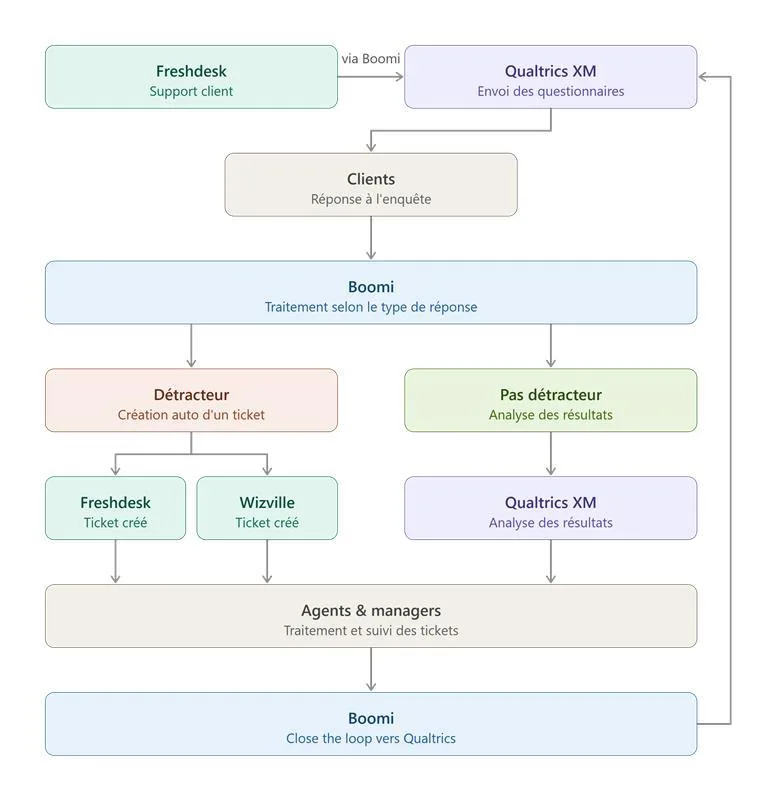
Boomi is therefore the connection point between the different data sources and makes it easier for data to flow through business processes.
From isolated data to better customer knowledge
One of the main benefits of integration is being able to cross-reference data from the different tools.
For example, a customer expresses dissatisfaction in Qualtrics. This information can be matched with tickets recorded in Freshdesk or reviews collected via Wizville. The company then has more context to understand the situation and identify the causes of dissatisfaction.
This approach helps answer essential questions:
- What are customers’ main pain points?
- Which problems come up most often?
- Is there a link between support requests and satisfaction?
- Which actions should be prioritised?
Data thus becomes more than just an indicator: it becomes a source of knowledge and decision support.
Information better shared between teams
Integration also addresses an organisational issue.
Customer data can be of interest to several teams: customer service, customer experience, operations, quality, marketing or business teams. When this information stays siloed, sharing it can take time and create inconsistencies.
By making data flow more easily, integration creates a common knowledge base.
Information collected in Qualtrics can thus be used in a support-related process. Customer feedback identified in Wizville can be linked to an operational issue. Teams then have a more complete view and can better coordinate their actions.
Automating to work more efficiently
Connecting the platforms also reduces manual processing.
Data exchanges can be automated, limiting re-keying, manual transfers and the risk of errors. Staff can spend more time analysing feedback and resolving customer issues.
| Before integration | With Boomi |
|---|---|
| Data in silos | Connected data |
| Manual re-keying | Automated flows |
| Partial view | Richer customer view |
| More complex exchanges between teams | Information better shared |
| Decisions based on isolated data | Better contextualised decisions |
Integration therefore improves both operational efficiency and the quality of the information available.
Turning feedback into action
Collecting customer feedback only has value if it leads to action.
By matching Qualtrics and Wizville feedback with operational data from Freshdesk, the company can better identify recurring pain points and understand their causes.
A drop in satisfaction can thus be analysed alongside the requests sent to support. A recurring review can reveal a problem in a process. Teams then have more information to define priority actions.
Integration therefore makes it possible to move from “measuring satisfaction” to “using satisfaction to improve processes”.
A smoother, more consistent customer experience
The end benefit is directly visible in the customer relationship.
When teams have better shared information, they can put their interactions in context, avoid repetitive requests and give more appropriate answers.
The customer thus enjoys a smoother, more consistent and more personalised experience, whatever the point of contact.
This continuity rests on a simple principle: the customer should not suffer from the silos between the company’s different systems.
Conclusion
Integrating Qualtrics, Freshdesk and Wizville with Boomi makes it possible to move beyond siloed data management and build a more complete view of the customer experience.
By connecting the different information sources, automating exchanges and making it easier for teams to share data, the company can understand its customers better and make better-informed decisions.
Beyond the technical side, integration is thus a genuine business lever: it turns data into knowledge and knowledge into action, and helps deliver a smoother, more consistent and more personalised customer experience.