Blog
Medallion architecture: organising a Data Warehouse with Microsoft Fabric
Applying the medallion architecture (Bronze, Silver, Gold) in a single Microsoft Fabric Data Warehouse, rather than on data spread across several zones.
4 min readZakaria OBOUHO
- Microsoft Fabric
- Data Warehouse
- Lakehouse
- Power BI
- Business Intelligence
- Gouvernance des données
In modern Data Engineering and Business Intelligence projects, one of the main challenges is organising data in a way that is reliable, able to evolve and easy to use. The medallion architecture is a model particularly well suited to taking data from its raw state to clean, enriched data that is ready for analysis.
In many environments (including Microsoft Fabric), this model is often implemented by putting each layer on a different component — one Lakehouse per zone, for example. This article presents an alternative approach: centralising all three layers directly in the Data Warehouse, to simplify governance, SQL access and maintenance.
What is the medallion architecture?
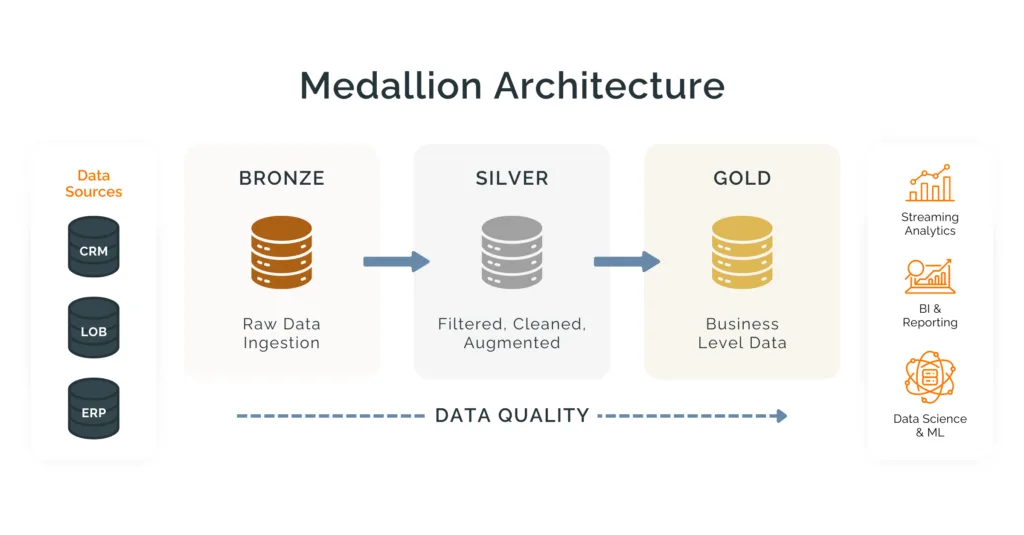
It is based on three transformation layers, plus a consumption layer:
- Bronze: raw data, as received from the sources (ERP, CRM, files…).
- Silver: cleaned, deduplicated and standardised data.
- Gold: data structured for business needs (dimensions, facts, KPIs).
- BI (consumption): visualisation via Power BI, reports and dashboards.
Why centralise the three layers in the Data Warehouse?
Rather than spreading Bronze, Silver and Gold across separate storage zones (for example one Lakehouse per layer), it is possible to bring the whole data lifecycle together in the Data Warehouse, as successive tables and views. This centralisation brings several concrete benefits:
- A single SQL entry point for all tools (Power BI, ad hoc queries, procedures) without depending on an external engine or data lake.
- Simpler governance, since access rights, the schema and the catalogue are managed in one place.
- Precise control of the target schema, by creating empty tables before loading rather than letting the schema be inferred automatically.
- Less duplication and latency between layers, since Silver → Gold transformations run directly in the Warehouse (procedures or dataflows).
Bronze — Raw
The Bronze layer contains data as it arrives from the source systems.
Silver — Cleaning and integration
Bronze data is transformed and consolidated in an intermediate table in the Data Warehouse. Examples of processing applied:
- removing duplicates;
- handling null values;
- normalising formats;
- converting types;
- quality checks;
- matching between sources (e.g. Salesforce ↔ ERP);
- applying the first business rules.
Gold — Business model
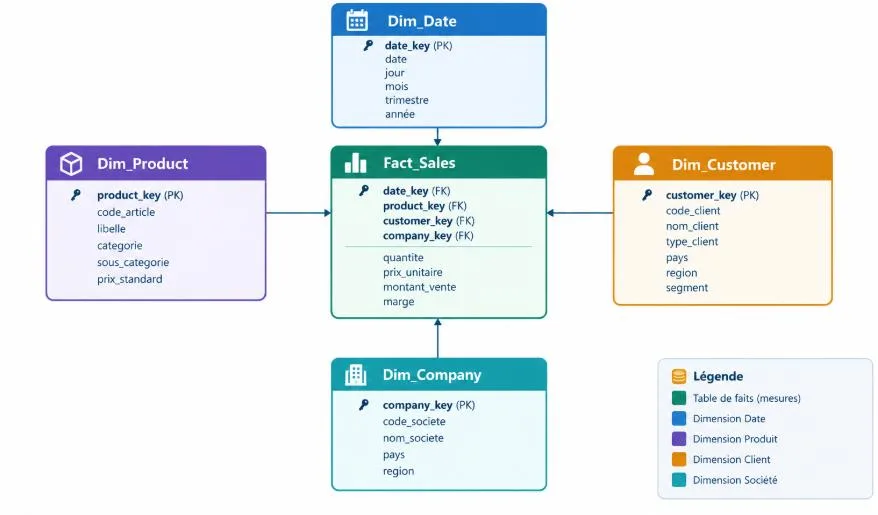
The Gold layer exposes data that business users and Power BI can use directly, as a view or a physical table in the Data Warehouse. A star schema can be built:
Centralisation in practice in the Data Warehouse
In a real project, raw ingestion can go through a Lakehouse, but all the medallion processing — receiving, cleaning, exposing — is then centralised in the Data Warehouse, as empty tables created in advance and then filled via a Copy Data activity in a Pipeline. The mapping is as follows:
| Medallion layer | Object in the Data Warehouse | Role |
|---|---|---|
| Bronze | stg table |
Receives the data copied from the sources (via the Lakehouse or directly), before any cleaning |
| Silver | table cleaned |
Deduplicated, typed, standardised data, with business rules applied |
| Gold | view finaldata |
Final business view, exposed directly to Power BI through the Warehouse SQL endpoint |
Technical implementation: pipeline and stored procedures
Automating the flow relies on two simple building blocks, both centred on the Data Warehouse:
- A Pipeline orchestrates loading: a Copy Data activity copies data from the source (or the ingestion Lakehouse) directly into the Warehouse
stg tables, without transformation. - SQL stored procedures, created in the Warehouse, then apply the Bronze → Silver transformations: deduplication, typing, normalisation, business rules, to produce the
cleanedtables. - An additional stored procedure (or view) builds the Gold layer (
finaldata) from thecleanedtables, ready to be consumed by Power BI. - The Pipeline chains the Copy Data activity and then the execution of the stored procedures (Stored Procedure activity), which automates the whole Bronze → Silver → Gold flow without ever leaving the Data Warehouse.
Centralised flow implemented:
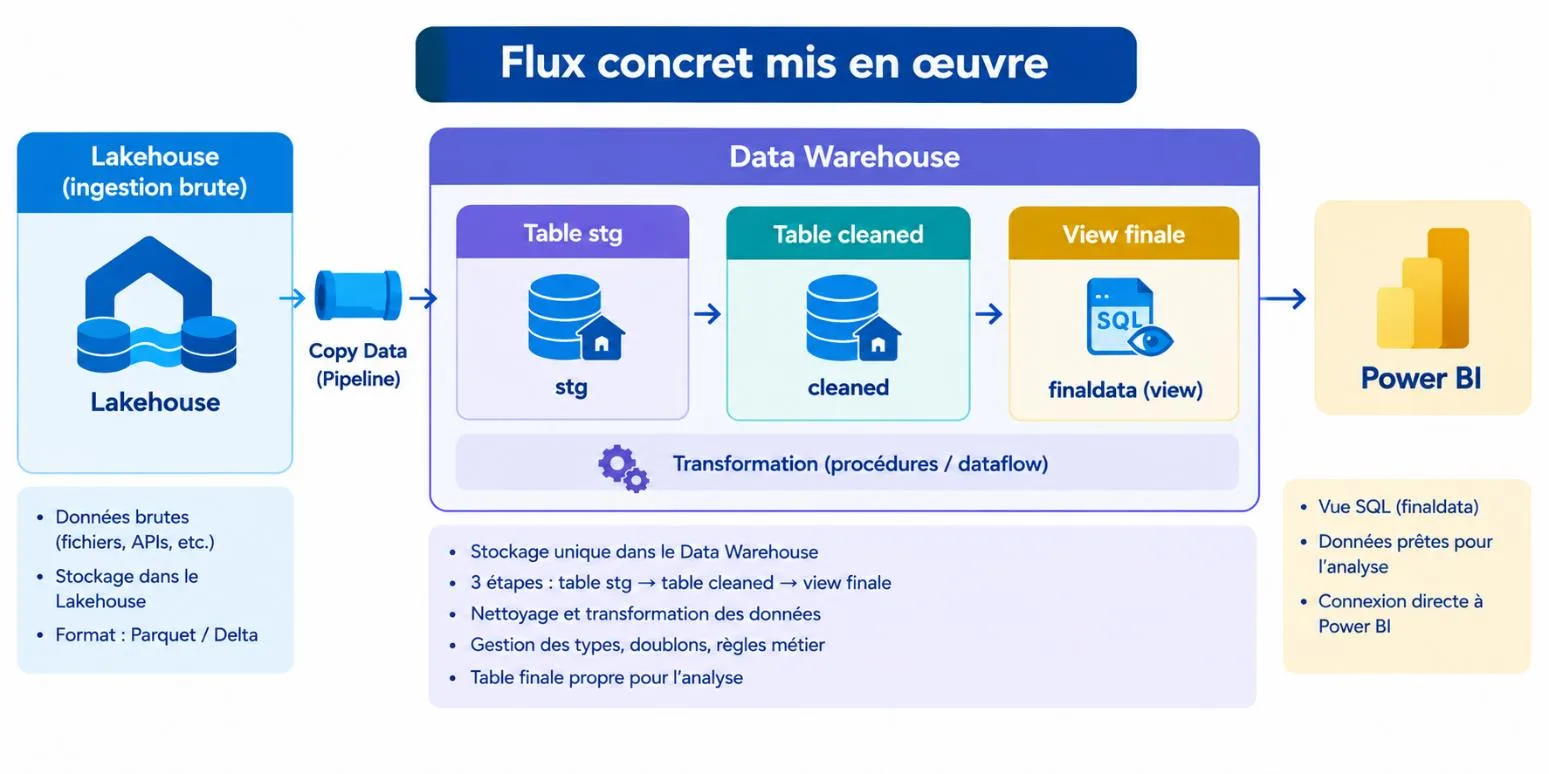
Notes: creating the empty tables before the Copy Data makes it possible to control the target schema precisely rather than letting it be inferred automatically. The
stg tableacts as a Bronze zone directly in the Warehouse, which means SQL tools do not depend on external access to the Lakehouse. Thefinaldataview stays light and continuously up to date; if volumes grow large, materialising this Gold layer as a physical table — still in the same Data Warehouse — can improve performance without ever leaving the central warehouse.
Conclusion
The real value of the medallion architecture is not creating three layers for the sake of it, but clearly separating responsibilities at each stage of the data lifecycle. By centralising these three layers in a single Data Warehouse, you get data that is more reliable, governed, maintainable and performant, while simplifying the infrastructure and SQL access.
RAW → CLEAN → BUSINESS → ANALYTICS
Bronze keeps the truth of the source, centralised in the Warehouse. Silver builds quality, without leaving the Warehouse. Gold builds business value, exposed directly from the Warehouse to Power BI.