Use case
How a leading retailer in Morocco digitised its import supply chain end to end
Proformas, booking, container tracking, customs clearance and finance in a single platform: lessons learned from a leading retailer in Morocco.
4 min readKhawla MOUSTAFI
- Supply chain
- IDP
- Retail
- Digitalisation
- Plateforme sur mesure
In many retail groups, import operations still rely on emails, Excel files and manual invoice approvals, leading to poor visibility, longer lead times, reconciliation errors and a heavy dependence on human exchanges.
For a leading retailer in Morocco, this fragmentation had become critical: hundreds of Proforma Invoices processed every month, multiple containers to track, and exchanges involving purchasing, finance, freight forwarders and international carriers.
The challenge: not to digitise one isolated step, but to build a platform able to orchestrate the entire import chain.
In this article, we share how an end-to-end digitisation approach transformed the management of import operations at a major player in Moroccan retail.
When import operations are scattered across emails, files and manual approvals
Previously, import operations were spread across purchasing, finance, freight forwarders and international suppliers, with no centralised tool. Each step generated its own flows: receiving PIs by email, manual approvals, follow-ups, financial reconciliations, customs checks.
The result: laborious tracking, bottlenecks that were hard to identify, costs that were difficult to anticipate, and a significant share of time taken up by low-value tasks.
1. Centralising Proforma Invoices to unblock the purchasing flow
The transformation started at the entry point of the process. PIs (Proforma Invoices) are uploaded directly from supplier submissions and processed by an Intelligent Document Processing (IDP) solution that automatically extracts the key information: supplier, amounts, item references, currencies, commercial terms. The data then feeds a structured approval workflow with role management and automatic notifications.
Teams now have a consolidated view of all PIs — statuses, outstanding amounts, payments and alerts — from a single source shared between purchasing, import and finance. Approval time has gone from several days to a few hours.
2. Automating booking to free up operational teams
Before the project, import teams handled quote requests, carrier follow-ups and rate comparisons manually, which limited their responsiveness and their ability to manage operations.
The solution now automates the entire process. Quote requests are automatically sent to approved carriers, while offers are centralised in a single space where they can be compared on several criteria (cost, transit time, ports, container type and transport terms). Each step is logged to ensure full traceability of requests, offers and decisions.
Once the carrier is selected, the shipment is initiated directly from the platform, based on the Proforma Invoices approved by the purchasing teams. The logistics information is then completed to track the import operations. This approach ensures data continuity, limits double entry, reduces inconsistencies and improves coordination between the purchasing, import and logistics teams.
3. Real-time visibility on shipments and containers
One of the project’s main challenges was the lack of visibility on international shipments. Thanks to the digitisation of booking and shipping operations, teams can now track all containers directly from the platform.
Each shipment file brings together the related PIs, transport information (booking, carriers, ETA/ETD) and the main import documents (Booking Confirmation, Bill of Lading, Packing List, Commercial Invoice, COC, etc.), providing a single digital file and making collaboration between the various parties easier.
An interactive map shows the journey of the goods, from the port of origin to their arrival in Morocco, with real-time tracking of the transport stages, port calls and key dates. This visibility improves operational planning, coordination between teams and the ability to react quickly in the event of a delay or anomaly.
4. Digitising customs clearance to control hidden costs
The transformation did not stop at transport. Document and regulatory management of import operations was also a source of risk, particularly because of double entry, processing delays and costs that were hard to anticipate.
Particular attention was therefore paid to digitising the freight forwarder file and customs clearance operations. The platform makes it possible to build, centralise and transmit files electronically, while tracking formalities until the goods are released.
Teams now have full visibility of file progress, deadlines, any blockages and the associated costs. Storage charges, demurrage and other ancillary costs are calculated automatically according to configurable business rules, improving financial forecasting and control of logistics spending.
This digitisation strengthens the traceability of operations, secures the processing of regulatory files and is an important lever for the operational and financial management of import activities.
5. Connecting import operations to finance
The final part of the project concerned integration with the Finance and Accounting teams.
Invoices related to import operations are now retrieved automatically from emails or added manually, matched to the corresponding shipments, then submitted to the business approval workflows.
The import supply chain is no longer isolated: it is fully connected to the company’s financial processes, with information finally flowing smoothly between the operational and accounting teams.
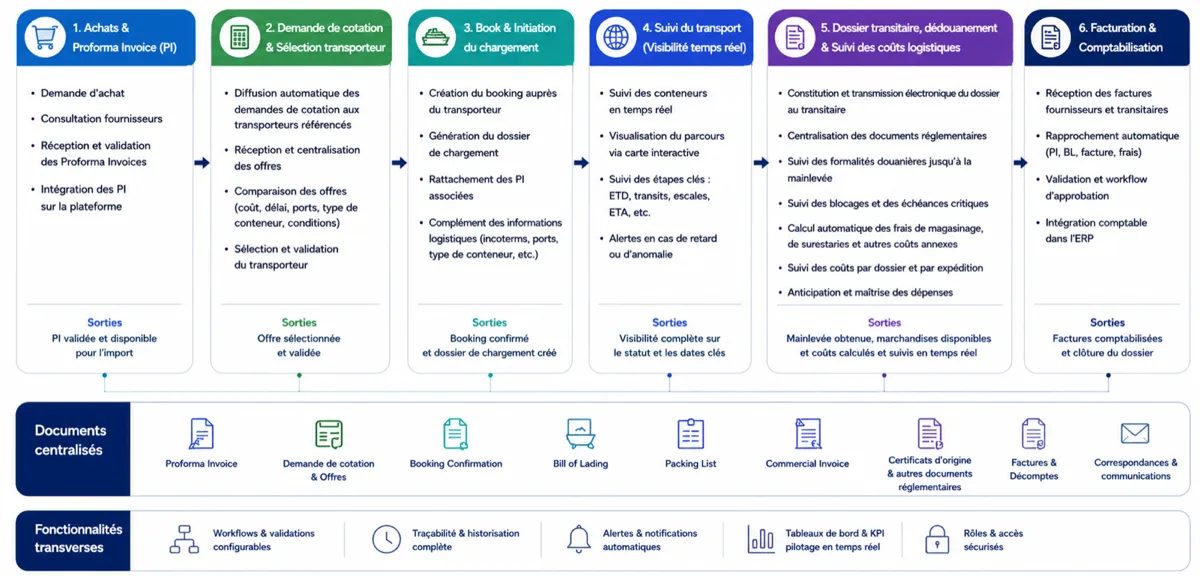
A single platform to manage the entire import chain: purchasing, transport quotes, shipping, container tracking, customs clearance, logistics costs and finance.
The main benefits of the transformation
- End to end beats partial automation. Digitising a single step moves the bottleneck without removing it. The real value emerges when purchasing, transport, customs clearance and finance are connected in the same solution.
- Manual exchanges are a risk indicator. The more operations rely on emails and shared files, the stronger the dependence on individuals. Mapping these flows before starting is essential.
- Results show quickly. Centralisation, automation and traceability deliver gains from the first phases, without waiting for a complete overhaul of the information system.
Beyond optimising import operations, this project is part of a digital transformation approach aimed at making processes smoother, strengthening collaboration between teams and making shared data more reliable. It illustrates how supply chain projects are evolving, where the goal is to connect people, data and processes within a single platform to improve visibility and control of operations. In an increasingly complex environment, this approach is a genuine lever for performance and competitiveness.