Blog
Workato in action: the power of iPaaS
What an iPaaS is, how Beebay fits it into a hybrid architecture, and what Workato brings: connectors, recipes, AI, APIs and its pricing model.
5 min read
- Workato
- iPaaS
- Automatisation
- API Management
In an IT ecosystem that is increasingly distributed, interconnected and real-time, integration is no longer just a technical requirement: it is a driver of performance. Companies need to connect SaaS applications, legacy systems, databases, APIs and complex data flows… all with agility, resilience and scalability.
That is exactly what an integration platform as a service (iPaaS) makes possible: standardising, orchestrating and automating exchanges between systems through a unified, low-code/no-code interface, designed for IT teams and business users alike.
Beebay builds iPaaS into an overall hybrid architecture strategy to boost operational efficiency. In partnership with vendors such as Workato, we help our clients build lasting, agile and scalable integrations that support their digital transformation.
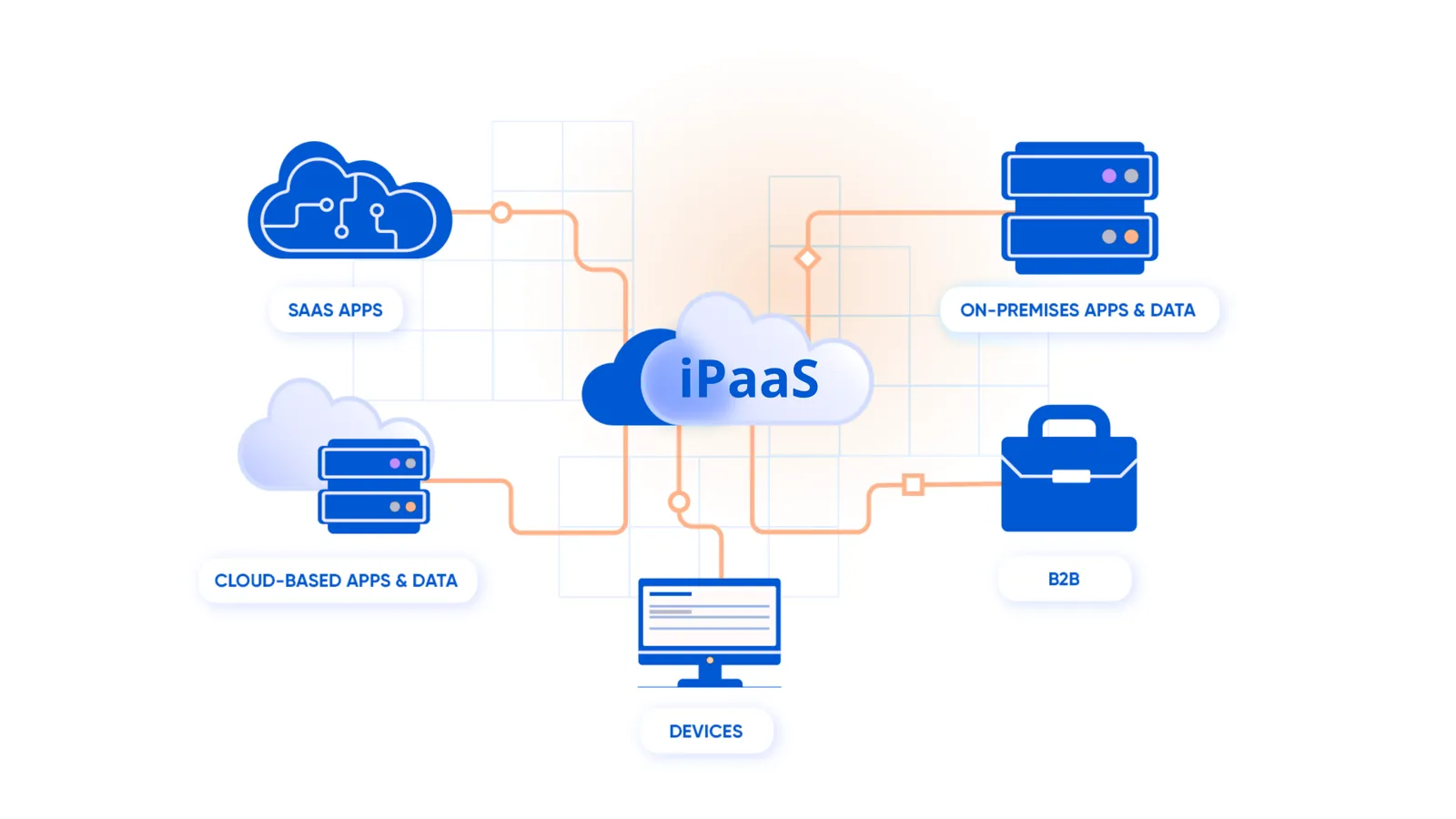
What is an iPaaS?
Integration platform as a service (iPaaS) is a suite of cloud solutions, often low-code, that allows companies to integrate and manage data flows between applications hosted in varied environments (cloud, SaaS and on-premise). Originally designed for mid-range SaaS integrations, iPaaS has evolved to fit into broader hybrid integration architectures. Today it acts as a technology bridge between cloud systems and on-premise infrastructure, providing tools for orchestration, data transformation, API connectivity and flow monitoring, while making centralised governance easier.
How Beebay positions iPaaS in its integration strategy
Beebay sees iPaaS not as a mere integration tool, but as a central pillar of modern hybrid architecture. In an environment where legacy systems, SaaS applications, cloud platforms and distributed databases coexist, iPaaS makes it possible to make these systems interoperable, scalable and manageable.
We integrate these platforms into an overall approach that aims to:
- Orchestrate data flows between the various business systems, internal and external.
- Standardise exchanges through prebuilt connectors and modular workflows.
- Speed up time-to-market with a low-code/no-code approach that encourages collaboration between IT and business teams.
- Ensure the governance, security and traceability of integrations through centralised monitoring.
Our approach is based on the conviction that iPaaS is a strategic building block for supporting companies’ digital transformation, by simplifying the information system’s architecture, reducing technical debt and strengthening operational resilience.
It is in this context that we chose to work with vendors such as Workato, whose flexibility, functional depth and user experience make it an accelerator for integration at scale.

Why choose Workato
Workato combines integration power with ease of use, with a low-code/no-code approach that makes collaboration between IT and business teams easier.
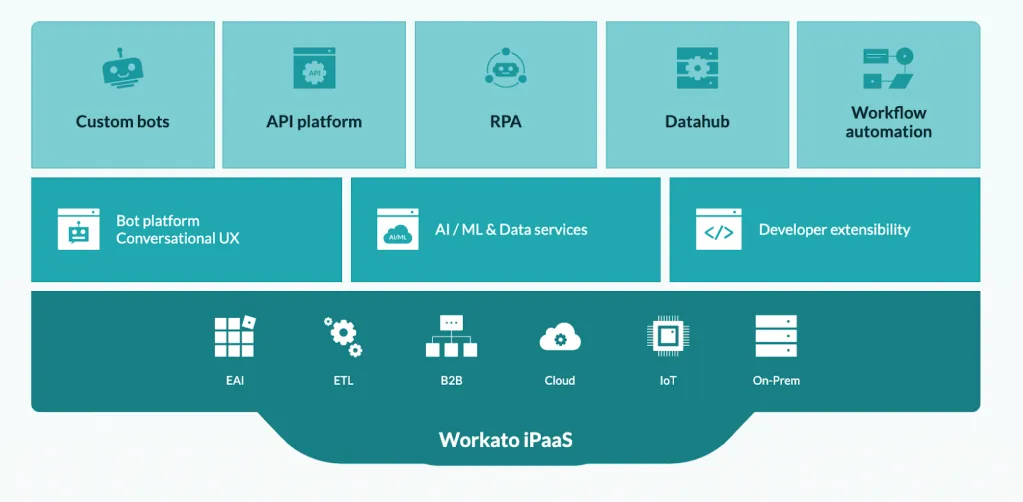
Its ecosystem includes:
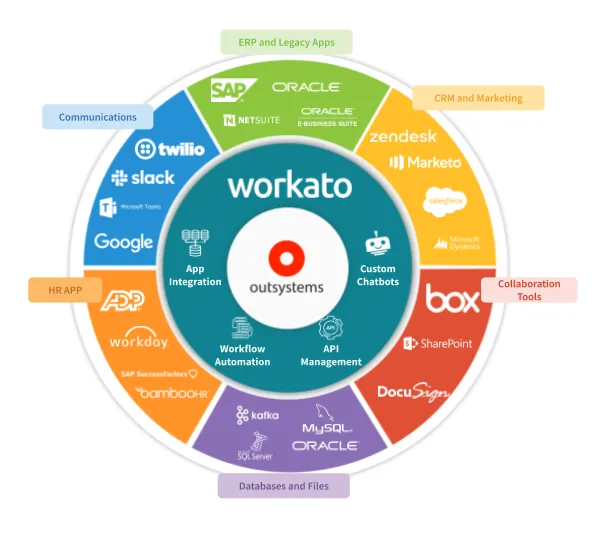
- An extensive library of connectors (ERP, CRM, databases, APIs, collaboration tools)
- A real-time orchestration engine, with error handling, conditions and multi-source triggers
- Scalability, monitoring and security capabilities suited to enterprise environments
- An interface designed to speed up deployment and reduce technical debt
An ideal solution for industrialising complex integrations while keeping agility and control.
Main features
1. Low-Code/No-Code platform
The Workato platform is designed for users, technical or not, and lets them build integrations through a visual interface. This approach speeds up development and reduces the need for complex coding.
2. Prebuilt connectors and recipes
The platform offers a vast library of predefined connectors and “recipes”: automated workflows that can be customised to meet the company’s specific needs. These resources speed up the integration process and encourage good practice.
3. Real-time data processing
Workato supports real-time data synchronisation, ensuring that information across integrated systems is up to date, which is crucial for fast decision-making.
4. AI and machine learning integration
With features such as Agent Studio, Workato lets users build AI-based agents on a low-code/no-code platform, extending automation capabilities.
5. API Management
Workato provides robust API management tools, allowing companies to create, publish and monitor APIs efficiently, making communication between applications smooth.
Advanced connector capabilities
Workato stands out in the iPaaS landscape thanks to its advanced connector features, giving greater control and flexibility to integration developers and business users alike.
1. Granular trigger conditions
The Workato platform allows precise control over trigger conditions. Users can define specific criteria that determine when a workflow should start. For example, a recipe can be configured to trigger only when a Salesforce account is rated “Hot”, ensuring that only relevant events activate the workflow.
2. Smart data handling
Workato connectors are designed to provide smart data handling. They clearly separate mandatory and optional fields and specify the expected data types. This clarity helps users map data accurately and reduces the risk of errors during integration processes.
3. Simplified authentication
Setting up connections in Workato often uses standard user login credentials, simplifying authentication. This approach relies on familiar sign-in methods, making it easy for users to connect applications without complex configuration procedures.
Use cases
The versatility of Workato shows in its wide range of use cases across sectors:
- Human resources: automating employee onboarding by integrating HR systems with IT and communication tools.
- Sales and marketing: synchronising customer data between CRM and marketing platforms to optimise lead management.
- Finance: automating invoice processing by connecting accounting software to procurement systems.
- Customer support: integrating help-desk ticketing systems with communication platforms to improve response times.
- IT operations: monitoring system alerts and automating incident responses to maintain system availability.
Pricing model
Workato offers a flexible pricing structure that meets different organisational needs:
- Workspace plans: these plans give access to the platform’s key features, including unlimited application connections, recipes and users.
- Task plans: pricing is based on the number of tasks executed, with plans starting from one million tasks.
Benefits and considerations
- User-friendly interface: the low-code/no-code approach allows a wider range of users to build integrations.
- Scalability: Workato can handle complex workflows and large data volumes, making it well suited to growing companies.
- Extensive integration capabilities: the platform supports a wide range of applications and systems, adding to its versatility.
- Cost: the pricing structure can be a barrier for small organisations or those with limited integration needs.
- Learning curve: although user-friendly, the platform may take some users time to master fully.
How can we help, and what do we do to implement Workato?

Beebay helps you choose and adopt the iPaaS solution best suited to your business objectives, your application landscape and your technical constraints. We take a modern, modular and scalable approach to integration to meet requirements for performance, security and scalability.
Our teams of experts design integration patterns robust enough to cover a wide range of use cases: integrating SaaS solutions, connecting to legacy systems, synchronising flows between applications, exposing strategic APIs, or data pipelines for machine learning and artificial intelligence applications.
As an official partner of Workato, one of the leaders in the Gartner Magic Quadrant for iPaaS platforms, we use the most advanced tools on the market to connect your cloud applications, your APIs, your data and your legacy systems, while ensuring traceability, security and scalability. Our experts configure your iPaaS platform, industrialise your integration flows and set up an agile, secure delivery framework fully aligned with the pace of your IT and business teams.